Week 6 Uniform Matchup Rankings


In a minute, the Week 6 rankings.  But first, here is Rob to tell you a bit about things going on here at The Gridiron Uniform Database.

~ ~ ~ ~ ~

Thanks, Tim.  First I want to publicly recognize here in the blog your appearance on the Leatherheads of the Gridiron's podcast, "Gridiron Greats."  Tim (who was introduced as the "owner" of our site) did us proud in an almost 45-minute interview where he talked with hosts Bob Swick and Joe Squires about our site and other interesting stuff like his collection of Super Bowl game programs.  (He has every one)  The show is geared towards memorabilia and collecting, but it was an interesting discussion none-the-less.

You can download the mp3 of the appearance here.

Another thing I wanted to mention, in sending me the commentator listings for this week from his research over there at The506, (where Tim is one of the curators of all of the historical announcer information that you see here on our site), Tim also included the game announcers from NFL games played 50 Years Ago this week in 1962.  (I swear, we're not trying to steal a similar idea from someone over at that other site.)

As you all know, while we like to think that we have already included a quite impressive amount of information of pro football uniforms from 1920 to the present, we have easily 80% of the task still to go.  A lot of the time-consuming entry of weekly and matchup pages is simply just going to take a lot of time.  So we are going to continue to try making headway towards our ultimate goal of completeness by adding the 1962 season, beginning with the current week 50 years ago, and working forwards and backwards from that point.

This week, I have added 1962 Week 6 (and AFL Week 7), and next week, we'll shoot for adding Weeks 5 and 7, and continue to build from there.  Also, if you go to the 1962 season page, you'll now see links to the weekly pages, and we will be adding these to the other years in coming days as well.  I know there are a lot of older matchup pages that I have added to the database, but frankly, there is no easy way to see how they are indexed and which ones are included, so I will be adding these 'weekly indexes' at the top of all of the year index pages in coming months.

Now back to Tim with the Weekly Uniform Rankings.

~ ~ ~ ~ ~

#14. Colts-Jets: IND in all white, NYJ in green/white. The safe way to go for the Jets. I would have preferred the Jets in a green/green get-up. So, this then becomes a rather mediocre matchup. Plenty of white, if you like that.

#13. Bengals-Browns: CIN in black/white and CLE in all white. Back in week 2, these two played each other with the Bengals doing a rare turn of white at home (WAH), forcing the Browns to wear brown jerseys for the first time in the regular season since 2010. This time, the Browns return the favor. Lots of orange and the Bengals play it conservative with the white pants instead of black pants. It's OK.

#12. Rams-Dolphins: STL in all blue, MIA in all white. Mono a mono from head to calf. It's a so-so look. Were the Rams to go blue/gold and the Dolphins to go white/aqua, OMG...But alas. Still some good color here, blue, gold, aqua, orange. Just not enough of it here.

#11. Patriots-Seahawks: NE in white/navy, SEA in all navy. While I have bought into the Seahawks new sweetness, it doesn't work against the Patriots standard white/navy away combo. Seattle could have busted out gray pants, and that would have helped. Just too much navy leaves me blue.


10) Bills-Cardinals: BUF in white/blue, ARZ in black/white. WHA...? Bills in BLUE pants?? Yay-yuh! Oh yeah! Woo-hoo! This is the bes...oh wait, Cardinals in black jerseys instead of red??? Um...never mind. Next, please.

#9. Lions-Eagles: DET in white/silver, PHI in green/white. This looks a little too much like a Cowboys-Eagles matchup, with the Eagles fanbase normally in venom mode. With the Lions in town instead, I think this game would have been better served for all involved if the Eagles would've gone WAH to force the Lions to rock honolulu blue. Good, not great.1

#8. Cowboys-Ravens: DAL in white/mint, BAL in purple/black. Cowboys in the normal mode with the Ravens again rocking the purple and black. Yup, I like it. When the Ravens brought the NFL back to Baltimore in 1996, this was what they wore at home. They have resumed this look in recent years and I think it fit the team image to a "B". Blends well with the Cowboy gear.

#7. Vikings-Redskins: MIN in all white, WSH in burgundy/yellow. This one works. Vikes in the standard purple trimmed whites and the Redskins continue to spread good cheer with the burgundy-yellows. A very nice look here.

#6. Steelers-Titans:  PIT in white/yellow and TEN in columbia blue/navy blue. Nice color contrasts here. Black, yellow, and two shades of blue. Both teams in three separate colors for the helmet, jersey and pants. May not be the best matchup, but an upper echelon one for sure.

#5. Giants-49ers: NYG in white/gray, SF in red/gold. Nice load of reds in this one. Could have been a pinch more blue here, but the red is nice and blended with good doses of blue, gray and gold. This is traditional and traditionally good.

#4. Raiders-Falcons: OAK in white/silver2, ATL in red/white. Really gave the bum rush to the Falcons last week, but this week is much nicer with the Falcs in the red, and it's a good contrast against the rather muted Raider aways. Dig it.

#3. Packers-Texans: GB in white/yellow, HOU in dark blue/white. A better than average matchup. No surprises and none needed. A good blend of good colors, white, green, yellow, dark blue and good ol' battle red. Certainly goes in the win column.

#2. Chiefs-Buccaneers: KC goes red/white, TB goes white/pewter. Nicely done. Bucs shun the white/white for a better look with pewter pants3, and bounces well off the Chiefs red and white tradition. An above average matchup.

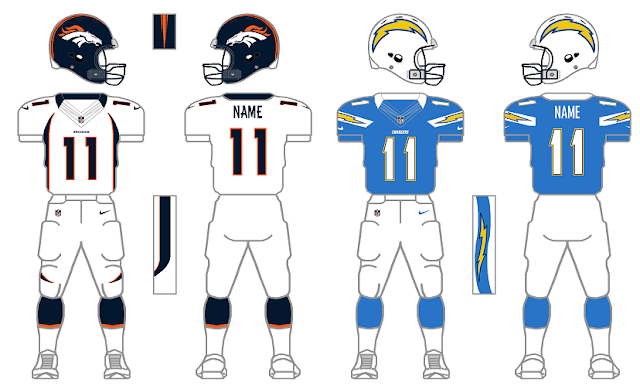
#1. Broncos-Chargers: DEN in all white, SD in powder blue/white. One of those games where the team that wears a very popular (and justly so) alternate that will ratchet up the matchup no matter what the other team looks like. This is certainly the case when the Chargers - all too rarely - break out the powders. The Broncos are the opponent and are wearing the navy based whites with the touch of orange.


Back next week. Till then, Peace Out.4

1- Could have been worse, they could have dressed like this.
2- Whenever I see Oakland in road unis in a dome, I think of this game.
3- Like all of the Weekly Rankings, the opinions issued in the Weekly Rankings are only those of Tim Brulia, and not necessarily in agreement with everyone's opinion at the GUD. I (Rob) happen to prefer my Bucs in white pants and hate the pewter pants. The white/white is fine, but I happen to think their best look is the red/white, which they seldom wear. Still he put the Bucs at #2. Also, I would have had the Bills-Cardinals much higher. Even with the Cardinals' BFBS (which I actually don't think is that bad (gasp!), the debut of the Bills' blue pants would have easily been Top 5 and probably #1 for me.

4- What's with the footnotes? I don't know, maybe I've been reading too much Bill Simmons lately.

If Now Was Then... (Part 5)

Over the past month, I've provided some concept art for your amusement. Under the premise of "What would the current NFL teams look like is today was the era of long-sleeve jerseys and leather helmets," we have looked at the NFC teams and their 'retro' looks.

Today we begin the second half of the story...the AFC.

As I mentioned last week, the recent AFL documentary entitled "Full Color Football" was partially (or even maybe wholly) named for the fact that the AFL teams were clad in uniforms much more colorful and vibrant than their NFL counterparts at the time. I have embraced that line of thinking for the majority of the AFC teams whose heritage traces back to the early days of the American Football League.

With that being said, I present to you...
 
The AFC North
BALTIMORE – Their current jerseys lack sleeve stripes, so I stuck with that. Removing the outlines and drop-shadows on the numbers, I still kept the same font.  A purple helmet with a black flying wing (ravens are black) works well.

CINCINNATI – When I got to the Bengals, I thought “If any team was going to push the boundaries of World War II-era uniforms it would be Cincinnati.” I have a soft spot in my heart for the mono-orange Brooklyn Tigers uniforms so I “Cincy-fied” that combination for the primary. What are Bengals without stripes? Tame by comparison to today’s standards, I made the cuff-to-cuff stripes striped in the non-jersey colors. Black and white stripes on the orange jersey and orange and white stripes on the secondary black jerseys. I didn’t stop there. Drawing on some fine hosiery of the 1930s Bears, I gave the Bengals socks the black-white-orange barber pole effect. A black leather helmet with orange stripes tops this neon-sign of a uniform.

CLEVELAND – Like Chicago 4 weeks ago, this was easy. Brown and orange versions of Cleveland jerseys from the 1940s (AAFC) and 1950s. These ARE Cleveland.
 
PITTSBURGH – Aside for the black and yellow striped helmet, these were the World War II-era Steelers. They look sharp. Oh, and the Steelers NEED to be in block numbers.

Well, there is the AFC North. I'll be back next Tuesday with the AFC East.
(My eyes are still burning from the Cincinnati combos! Ouch!)
Bill Schaefer

A Head-to-Head History: The New York Giants and The San Francisco 49ers


A Head-to-Head History: The New York Giants and The San Francisco 49ers

The 2011 NFC Championship Game was one of the most exciting, hard hitting and tightly contested games of the 2001 season, and it recalled a battle for the right to represent the NFC in the Super Bowl 22 years prior, which I wrote about in my very first blog for the GUD last January. For fans of both teams, the week leading up to the game was undoubtedly spent not only scouting match-up advantages, but also reminiscing to a time when the San Francisco - New York rivalry was white hot.

Between the years 1981 - 1993 they met in the playoffs six times, with the winner of the contest ultimately being crowned Super Bowl Champions four times. A dramatic Wild Card Game in 2002 brings the total of playoff meetings to eight, making the Giants the 49ers most frequent post season opponent (they've met Dallas seven times and have a 2-5 record against them) and San Francisco is tied with Chicago as the New York's most frequent opponent (they are 3-5 against the Bears, but five of those meetings predate the Super Bowl era.)

The series has not only been intense, it has been remarkably even. The regular season ledger has  each team with 14 wins apiece and San Francisco with the slightest margin of edges in total points scored with seven. The post season is even tighter, with a 4-4 split in wins and a miniscule two point lead for San Francisco. Memorable Prime Time contests, career defining moments, Hall of Fame Coaches and players and Championship Battles define this inter-division rivalry.

The 49ers were still something of a new commodity when they made a cross country trip to New York's Polo Grounds in November of 1952, this being only their seventh season of play and third since their migration from the AAFC to the NFL. As was common at the time, this game was color-versus-color. San Francisco was one of four teams to have only one jersey, and only four of the remaining eight teams had white as an option. The Giants primary jersey dating back to the late 1930's was solid red - there was no home-road designation at that time - so they would wear their alternate solid blue when they met a team red wearing team like the 49ers. The grey pants and blue shelled helmet with a red center stripe gave the Giants a look that would not be out of place today. The same could be said of San Francisco in regard to their jerseys and socks, which were red with three equal width white stripes. The only unfamiliar aspect with the 49ers of  today would be the silver helmets and pants, which were something of a variable. Over the first 17 years of their history the 49ers alternated between silver, gold and white as their secondary color, until permanently settling on gold in 1964.  Y.A. Tittle's 358 passing yards in the game were more than double than his counterpart and future teammate Charley Conerly's output, but four interceptions doomed the 49ers in the 23-14 loss.

The next meeting came on opening day of the 1956 season in San Francisco's Kezar Stadium. After an explosive first quarter that saw New York take a 17-0 lead, and the teams traded touchdown along the way to a 38-21 Giants victory. As in the game four years earlier, Tittle threw for over 300 yards in the failed comeback effort, but turned the ball over with three interceptions. This color-versus-color match-up featured San Francisco in solid white helmets and white pants with a broad red stripe with their same three-stripe red jerseys and socks. The Giants wore their same solid blue jerseys and stripe-less grey pants. This win was the first step for New York in an 8-3-1 season and NFL Championship victory over Chicago. It would be the Giants last title for 30 years.

1957 saw the NFL pass legislation, largely to accommodate the league's growing black-and-white television watching audience, declaring each team have two jerseys, one primary color and the other white. For the most part, home teams almost always wore their primary color jerseys at home and white on the road. This was the year the Giants actually became "Big Blue". Three thin stripes were to the pants (red-blue-red separated by grey) and bold white numbers to both the front and back of the helmet, flanking the red stripe. This uniform is nearly identical to what the Giants wear today. San Francisco had worn their first white jersey in 1955, which featured black and red stripes on the sleeves and black drop-shadows on the numbers, but they only lasted the season. Their latest white jersey incorporated the newly returned gold prominently, two of the three sleeve and sock stripes were now gold - and complimented the solid gold helmet and pants nicely. Tittle's team finally broke into the win column against the Giants in old Yankee Stadium, 27-17. San Francisco finished the year tied for first in the NFL Western Conference with the Detroit Lions, but fell victim to a Bobby Layne comeback in a 31-27 loss in a playoff.

1960 saw the teams meet on opening day at Kezar Stadium, in a very red and silver/grey match-up. The Giants of course wore the designated road white jerseys with red numbers and Northwestern sleeve stripes and red socks. San Francisco remained in their standard red jerseys with three white stripes and white block numbers, but silver was back as their complimentary color for helmets and pants. The helmets now featured a unique, red Northwestern style striping pattern. The Giants won a close game 21-19.

By 1963 many changes had occurred for both teams. Tittle was now in New York wearing blue and both teams helmets featured their first logos. The Giants were in their third season sporting their lowercase "ny" and San Francisco the red oval with the interlocking "SF". The 49ers helmets  also featured the same red-white-red striping pattern they use now, but they still fell on a silver shell. The road white jerseys featured two over-the-shoulder UCLA stripes. Tittle had a huge day against his former team with four touchdown passes, on his way to a then record 36 touchdown passes. The Giants would win the Eastern Conference but lost the title game for the third consecutive year.

When these two teams met in 1968 in Yankee Stadium, the rivalry was just beginning
When the teams met again in Yankee Stadium in 1968, the 49ers had found their signature look, and the Giants had embarked on a period of experimentation. San Francisco was now in "49'er Gold" for good, and although the pants stripes would eventually grow larger, the red-white-red pattern was set, and the red sleeve stripes on the white jerseys fell in the same the same three-stripe pattern as the white stripes on the red jerseys. For the Giants, although the solid blue home jerseys were the same, the pants were now white with an inverted blue-red-blue striping pattern, and the numbers on the front and back of the helmets were thinner and much larger. Fran Tarkenton and the Giants offense struggled as New York fell to John Brodie's 49ers 26-10.

The Giants started a five game win streak against the 49ers in 1972 with their first visit to Candlestick Park. The Giants white jerseys were now nearly absent of any red, appearing only in the thin blue-red-blue striping on the sleeve cuffs. By the second meeting in 1975 things had changed radically for New York. A major (and uncharacteristic) overhaul took place for the normally conservative Giants. White and red stripes were everywhere, and the pants featured broad blue and red stripes (with the white jerseys the pants were blue with white and red stripes). Most alarming though, was a bold, double-vision inducing "NY" logo on the helmet. Still more unusual than the Giants outfits that day, was the fact that both teams were in a simultaneous down period. For all five contests between the Giants and 49ers between
1975 - 1980, they finished with losing records at or near the bottom of their respective divisions.

When the 6-6 Giants visited 9-3 San Francisco in November 1981, neither team had any idea a major rivalry was about to be born. Over the next 12 years, a 49ers - Giants game was as important and as intense as any 49ers-Rams or Giants-Redskins battle. San Francisco and Bill Walsh's "West Coat Offense"  had the upper hand at the start, winning five straight, including two Divisional Playoff Games. The 49ers uniforms had not changed significantly, excepting the large width of the pants stripes. In the meantime, the Giants modified back to a more conventional style that greatly resembled their look from the early 70's. Blue-red-blue stripes ran down the white pants and across the cuffs and v-necks of the white jerseys, and the socks were again solid blue. The italicized, underlined "GIANTS" logo from 1976 was now on a helmet featuring a single red stripe and bold numbers only on the back.

The 1981 game was a low scoring affair, with the 49ers winning 17-10 in a tightly contested, defensive battle. The Giants won their last three games to finish with a  a 9-7 record and their first playoff birth since Y.A. Tittle's remarkable 1963 season. The 49ers also won out, closing the regular season with a franchise best 13-3 record and a first round bye. The Giants upset the Eagles in Philadelphia in the Wild Card Game, earning the right for a rematch with the 49ers. The game was a reversal of the recent pattern, with both teams scoring often. Scott Brunner had taken over for the injured Phil Simms late in the year and hit Johnny Perkins and Earnest Gray on long scoring strikes. Montana however, was more efficient and had a 300-yard effort as he completed passes to eight different receivers in the 38-24 win. This game was of course, the prelude to a classic as the 49'er dynasty officially launched against Dallas with Dwight Clark's famous catch the following week and ultimately a victory in Super Bowl XVI.

The teams did not meet until an October Monday night at Giants Stadium in 1984. The Giants home jerseys had changed quite a bit since San Francisco's last visit in 1979 - the rookie year for their quarterbacks Montana and Phil Simms. The pants and socks were unchanged from the road uniform. The royal blue jersey had white block numbers with red trim, and the sleeve cuffs and v-neck had red-white-red stripes. This would be the Giants standard uniform through the 1999 season. The improved look did not help New York though. San Francisco jumped all over the Giants early with big plays: a 59 touchdown by Renaldo Nehmiah and 79-yard punt return by Dana MacLemore gave San Francisco a 21-0 lead before the first quarter was over and the Giants were never able to amount a comeback, losing 31-10.

As in 1981, the teams would meet in Candlestick Park for a Divisional Playoff. The Giants again qualified as a Wild Card entry 2ith a 9-7 record, and the 49ers were the NFC's top seed with a 15-1 record (a new record for the most wins by an NFL team in the regular season.) San Francisco followed the same recipe for success: they jumped ahead early, scoring touchdowns on their first two possessions, before both defenses settled in and controlled the pace of the game. The Giants only touchdown of the game came on an interception return by linebacker Harry Carson in the 21-10 loss. The 49ers rolled on to their second championship in four seasons as they bested the Miami Dolphins 38-16 in Super Bowl XIX.

New York and San Francisco met in the post season again in 1985, only this time the game would be in the Wild Card round at Giants Stadium, New York's first home playoff game since 1962. The hallmarks of the Bill Parcells Giants were on full display that cold, windy afternoon: a rugged defense that sacked Montana four times and an offense that moved the chains and controlled the clock with the run as Joe Morris chugged for 141 yards on 30 carries. The Giants run ended in Chicago the next week, again bowing to the eventual Super Bowl champions.

1986 brought another prime time game and another playoff contest between the two NFC powers. The December 1 match-up on Monday Night Football remains a signature game for Simms and the pinnacle moment of teammate Mark Bavaro's career. Again jumping ahead early, the 49ers led 17-0 at halftime as their defense stymied the Giants run game {for the game, the Giants would finish with a measly 13 yards on 19 carries} and forced Simms into two takeaways {one fumble and one interception.} Facing a third down on their first possession of the third quarter, Simms found Bavaro short over the middle, who then dragged as many as seven San Francisco players up-field for over 20 yards. The Giants followed Bavaro's lead and stormed back to take a 21-17 lead before the period ended. The Giants held on through a tense fourth quarter, thwarting a Montana comeback effort on the last drive.

Giants Stadium was the setting for the Divisional Playoff in January. After forcing the Giants offense to a three-and-out to start the game, Montana hit receiver Jerry Rice on a slant that should've ended with a touchdown. Rice mishandled the ball while racing toward the end zone and the Giants recovered for a touch-back. Simms lead New York on an 80-yard march that ended with a touchdown toss to Bavaro and the Giants never looked back, winning 49-3. The Giants ultimately went on to win their first NFL Title since 1956 in Super Bowl XXI.

A Monday night game with replacement players during the strike in 1987 is not worth mentioning, but Rice atoned for his playoff gaffe at Giants Stadium in September 1988. Coach Walsh was enamored with his newly acquired quarterback Steve Young, and he split time with Montana during the game, with both achieving mixed results. Trailing 17-13 late in the fourth quarter though, Montana was at his most dangerous. He hit Rice with a short pass along the sideline, safety Kenny Hill took a bad angle on the tackle attempt and took out corner back Mark Collins, freeing Rice to go the distance as he secured the ball this time for a game winning 78-yard touchdown.

There would be no playoff meeting this season, but that did not mean the rivalry became dormant. Both teams finished with 10-6 records, but the Giants loss to the Jets on the season's final Sunday knocked them into second place in the NFC East. That put the Giants in the position of needing the 49ers to defeat the Los Angeles Rams that night to qualify as a Wild Card. Simms predicted the 49ers would "lay down like dogs" and the final score seemed to imply that was the case as the Rams rolled to an easy 38-16 win in Candlestick Park. San Francisco would regroup and coast through the NFC Playoffs and win a dramatic victory over Cincinnati in Super Bowl XXIII.

The Monday night game at San Francisco in November 1989 followed a familiar script with the 49ers jumping out to a 24-7 in the first half. Simms and the Giants chipped away, eventually locking the score up at 24 in the 4th quarter. An off-sides penalty on Giants special teams ace Reyna Thompson gave San Francisco kicker Mike Cofer a second chance on a long field goal and San Francisco escaped with a 34-24 win. The 49ers again  avoided a playoff match-up with the Giants thanks to the Rams, as they upset the Giants in a 19-13 overtime game at Giants Stadium. San Francisco then thrashed the Los Angeles following week in the NFC Title game and repeated   as Super Bowl Champs by beating Denver Super Bowl XXIV.

1990 brought another memorable Monday night game (and an already mentioned epic playoff game linked at the top of the page.) Both defenses dominated, limiting the opposing offenses under 150 total yards. All 10 points came in the second quarter, and Simms again attempted a comeback effort for the visiting Giants. Trailing 7-3 and faced with a fourth down deep in 49ers territory late in the game, Coach Bill Parcells passed on a field goal attempt that would've cut the lead to one point. The Giants pass attempt fell incomplete, but they held San Francisco to a three-and-out and received the ball with one more chance. Again advancing into the red zone, the game ended with a series of incomplete passes and 49ers safety Ronnie Lott and Simms exchanging heated words on the field after the gun.

Ottis Anderson runs through
49ers defense on a Monday
Night in 1991
Both squads underwent significant changes during the off season, but the 1991 season opener on Monday Night Football was eerily similar replay to the NFC Championship Game from the previous January. Although the Giants roster was mostly the same, coaching stalwarts Parcells and Bill Belichick were gone, and playoff hero Jeff Hostetler was named the starter at quarterback. The 49ers said goodby to Lott and Roger Craig, and had Young commanding the offense. Gone also were the stripes from San Francisco's socks, which were now solid red. The game itself saw another long range score by Rice - this time from 73 yards on a blown coverage, and the Giants finally hitting pay-dirt against their West Coast rivals on a one-yard run by Ottis Anderson to finish another methodical, time consuming drive. A pair of Matt Bahr field goals gave the Giants a halftime lead of 13-7. A San Francisco drive spanned the end of the scoreless third quarter and closed with a Young touchdown run early in the fourth. Taking over at their own 22-yard line with just over four minutes left, Hostetler drove the Giants into San Francisco territory. Bahr had missed a 51 yard attempt earlier in the quarter, but the 34-yard attempt with just 5 seconds remaining was good, and the Giants ended the 49ers NFL record road win streak at 19 games. However, for the first time since 1982, both teams finished on the outside of the NFC Playoffs. The Giants were 8-8 and would spend the rest of the 1990's in mediocrity. The 49ers were 10-6 and would spend the next several years battling the Dallas Cowboys for conference supremacy.

This trend is reflected by San Francisco's sweeping the next five games in the series, including a 44-3 Divisional Playoff blowout in 1993 that sent Simms and Lawrence Taylor into retirement. The regular season games in 1995 and 1998 in Candlestick Park were almost as one sided, with an cumulative score favoring San Francisco 51-13. The 1998 Monday night game saw the 49ers in the throwback-inspired uniforms that I wrote about in detail back in July: http://nfluniforms.blogspot.com/2012_08_19_archive.html

Given all the prime time exposure these teams received when they met, it should come as no surprise that the NFL chose to feature them in the first ever Thursday night season kickoff. By now, the Giants had returned toward their roots with their own version of an updated throwback-style uniform. Working from the Giants 1963 template, they grey pants were back, but with the 80's-90's blue-red-blue striping pattern. The brighter, metallic-blue helmet bore a bolder "ny" logo that hadn't been seen since 1974, and bold block numbers flanked the red center stripe. The game itself felt like throwback too. A tightly contested defensive effort that recalled the 1990 and 91 match-ups. This time however, the 49ers benefited from a game winning drive as Jeff Garcia hit Terrell Owens deep down the left sideline on first down, setting up Jose Cortez for a 36-yard kick and a 16-13 win.

Not to be outdone, the teams met in a dramatic {either unforgettable or infamous, depending on your point of view} NFC Wild Card Game the following January. The Giants, in their white jerseys with red numbers augmented by blue trim, roared out to a 28-14 lead at the half and extended it to 38-14 with only 4:30 remaining the the third quarter. The Kerry Collins-to-Amani Toomer connection had been unstoppable, connecting for over 100 yards and three touchdowns, and Tiki Barber added over 100 yards rushing with a touchdown of his own. Garcia responded with a quick touchdown drive that was capped by a crucial two-point conversion to Owens. The Giants went three-and-out, and Matt Allen shanked a feeble 29-yard punt from his own 13. Garcia responded in no time with a two play, 29-yard drive that again featured a two point conversion to Owens on the last play of the quarter. With the score now 38-30, the Giants went three-and-out again. Garcia led San Francisco on a 14-play drive that ate half the quarter and finished with a field goal, cutting New York's tenuous lead to 38-33. The Giants offense finally generated a few first downs before stalling at the 49ers 24. A low snap and bobbled hold cause Matt Bryant's field goal to sail wide, and Garcia capitalized on the momentum swing. Taking over on his own 32, he lead the 49ers to the New York 13 in under two minutes, then threw the decisive scoring pass to Tai Streets with 1:05 on the clock. The the two-point attempt failed this time, but the 49ers had a 39-38 lead. Following a kickoff return to mid-field, Collins completed three passes to get the Giants to the 49ers with 0:06 to go. Again, a poor snap-and-hold doomed the Giants, only this time holder Allen called "Fire!", rolled to his right, and launched a deep pass down field toward guard Rich Suebert, who was mistakenly penalized for being ineligible (although another Giants player Tam Hopkins was down field illegally on the play as well). Suebert was interfered by Chike Okeafor, but no flag was thrown, and the game ended with San Francisco being the beneficiaries of the NFL's second largest deficit overcome to win in the post season. The next day, NFL Vice President of officiating Mike Pereira acknowledged pass interference should have been called on Okeafor, with the offsetting fouls resulting in the Giants being granted an untimed down from the previous spot. The 49ers lost to Tampa Bay in the Divisional Playoffs the following week.

In 2002 playoffs, eligible lineman Seubert had a chance to be a hero
on a broken play, but he was interfered with, although it wasn't called
~ ~ ~ ~ ~

Both teams went into a period of struggle and renewal after the 2002 season. When they met again in November 2005 in Candlestick Park, the Giants were reemerging under the stewardship of coach Tom Coughlin and quarterback Eli Manning. The Giants also revamped their road uniforms, now drawing directly to the same ones they wore in 1958 with plain red numbers, red Northwestern stripes on the sleeves and the thin, separated red-blue-red stripes on the pants and solid red socks. The Giants defense had the upper hand, limiting the 49ers offense to just nine first downs and 138 total yards. Back-to-back meetings in the Meadowlands saw more of the same as changes at quarterback for San Francisco (Trent Dilfer in '07 and J.T. O'Sulivan in '08) couldn't solve their struggles.

When the 6-2 Giants met the 7-1 49ers in Candlestick Park last November, the 49ers had returned to their classic uniforms from the late 60's through the mid 90's (although the socks remained without stripes). It was fitting, because the 49ers were atop the NFC West and prepared to battle the Giants for NFC supremacy again. Defenses had the upper hand as San Francisco built a 12-6 lead midway through the 4th quarter in an exchange of field goals. After a Manning touchdown pass, San Franciso scored back-to-back touchdowns early in the fourth quarter for a 28-14 lead. A Manning touchdown pass cut the lead to seven and the Giants defense held Alex Smith's offense to a three-and-out, setting up another tense finish. Starting from their own 20 with 6:35 left, the Giants moved methodically to the San Francisco 10. On fourth-and-goal at 0:37, Manning's pass attempt was deflected by defensive tackle Justin Smith to preserve the win for San Francisco.

Both teams won their respective divisions and met again for the NFC Championship in Candlestick Park. Tight end Vernon Davis burned the Giants defense early on a 73-yard touchdown reception that featured fancy footwork to stay in-bounds along the sideline. The Giants offense moved the ball well in the first half, with Manning and wide receiver Victor Cruz connecting numerous times to send New York into the half with a 10-7 lead. The 49ers made defensive adjustments during the break, and began to clamp down, stifling the Giants passing game with fierce pressure (they'd finish the game with seven sacks and numerous other hits on the quarterback.) Another Davis touchdown catch regained the lead for the 49ers, but a special teams miscue by returner Kyle Williams set New York up with a short field when he let a punt graze his knee which was recovered by the Giants. On third down, Manning hit Mario Manningham for a 17 yard touchdown and a 20-17 lead with 8:40 remaining in regulation. Williams responded with a 40-yard return on the ensuing kickoff, and Alex Smith passed and scrambled San Francisco all the way to the New York seven yard line. The drive stalled at the New York seven and the 49ers settled for a tying field goal at 5:43. Both defenses tightened in the clutch, as six offensive possessions produced just one first down and the game entered sudden death. New York won the coin toss and both teams exchanged punts. On the third possession of the extra period, the Giants punted from their own 44. Williams fielded the punt, but had the ball stripped by Jaquain Williams and the Giants recovered on the 49ers 24 yard line. The Giants ran the ball three times and knelt once before Lawrence Tynes kicked the game winning field goal from 31 yards out, becoming the first player in NFL history to kick deciding overtime field goals in the post-season. The Giants went on to defeat New England in Super Bowl XLVI - making this the fifth instance the winning team from their playoff series advanced to win the Super Bowl.


~ ~ ~ ~ ~

San Francisco will be looking for revenge this Sunday, but if history tells us anything, its that this game will likely only serve as a prelude to another memorable playoff contest.

Week 5 Uniform Matchup Rankings (and R.I.P. Alex Karras)


 Getting to the uni rankings, but first...

The referees yet again change the uniforms. We started the season with replacement officials who wore positionless numbers on their backs. Then followed the normal refs with the position restored to the back. And THEN, we saw yet another change to the officials shirts this past Sunday, complete with a new font for both the position and numerals. On top of that, since we entered October, the NFL broke out the pink accessories, and this includes the officials. The referee caps for the month will feature the NFL shield superimposed over a pink ribbon and pink soutache stripes. The other officials will feature the same alterations to their black caps.

Meanwhile, many of the players will be suiting up with all sorts of pink accessories, such as sweat bands, pads, chinstraps, doo-rags, cleats and socks. We at the Gridiron Uniform Database will not be monitoring the pink players, but the normal uniforms as man intended.


#14. Falcons-Redskins: ATL in all white, WSH in burgundy/yellow. You know I dig on the 'Skins rockin' that burgundy and yellow mixture. But the Falcons dullish white whites drop this matchup for a loss.

#13. Bears-Jaguars: CHI in white/navy, JAX in black/white. Yup, the Jags make good on their announcement with their first appearance in the black jerseys. Ditching teal for this is a shame. Adds nothing to this matchup and thus, a drop in the standings. Sorry, Bears.

#12. Cardinals-Rams: ARZ in all white, STL in all blue. Lot of straight shot color here. Cardinals could have and should have broke out the red pants. Meanwhile, the Rams could have shot out the white pants. Not impressed with this one.

#11. Dolphins-Bengals: MIA in all white and CIN in all black. So, the big question is: have the Fish dumped the aqua pants for 2012?? After two away outings in white, sadly, that appears to be so. The Bengals help to compensate with their sleek all black threads. But not enough.

#10. Texans-Jets: HOU in white/navy. NYJ in green/white. Strange, but while these two in and of themselves have moderately good looks, when matched together, I find them rather dull. Plenty of nice color in navy, green and red, but I'm not getting that oomph feeling here.


#9. Broncos-Patriots: DEN in all white, NE in navy/silver. Both teams that overhauled in the late 90's/2000 era and haven't changed hardly at all since (Broncos switch to orange this season notwithstanding). Not that they should of course, but...just sayin.' A healthy dash of Bronco orange in some form would really appeal to me. As such, a rather average matchup.

#8. Ravens-Chiefs: BAL in white/black and KC in red/white. Ravens break out the white/black combo for the first time this season with the Chiefs in the predictable red and white appearance. The Ravens black pants saves this matchup from the abyss, but not enough, I'm afraid. The "Art" patch makes its debut on the Ravens white jerseys.

#7. Chargers-Saints: SD in navy/white, NO in white/black. I guess these interconference matchups perk up my intrigue meter. But again, this rare pairing has me in a positive funk. The Chargers navy, yellow with a sprinkle of powder blue against the vegas gold, black and white works for me.

#6. Packers-Colts: GB in white/yellow, IND in blue/white. In a similar vein to the Browns and Giants encounter, this pairing hearkens back to the days of Starr vs. Unitas. The unis remain similar and perhaps it's the sentimentalist in me, but these colors, while in a rather conservative mode, really work smoothly. Blues, green and yellow blend well here.

#5. Browns-Giants: CLE in all white and NYG in blue/gray. Close your eyes and visualize Jim Brown crunching against Sam Huff, Jim Katcavage and the gang. Open them and see virtually the same thing today, except it's MetLife Stadium and not Yankee Stadium. It's a good, classic, clean matchup.

#4. Eagles-Steelers: PHI in white/green, PIT in black/yellow. Two teams that share a commonwealth, a similar heritage and even - for a season - the same team. But alas, those days are long gone. Today, they share a good looking uni matchup. Green, white, yellow and black. Very nice, Keystone Kids!!


#3. Seahawks-Panthers: SEA in navy/gray. CAR in all white. First time the Seahawks have paired up this combo in these new unis and the first time the 'Hawks have done a non-monodark combo since 2005, and it's a refreshing change. Sharp get-up and works well with the Panthers all whites.


#2. Titans-Vikings: TEN in white/columbia blue, MIN in purple/white. I am quite surprised that I quite like this pairing. Purple, navy, columbia blue and they way they are used here just pleases my palette. Perhaps it's because this is a very rarely seen matchup. I dunno. I just have my thumbs up for this one.

#1. Bills-49ers: BUF in all white with SF in red/gold. One minute I'm thinking the Bills all whites looks drab against the sharp red and gold Niner clothing, but on second thought, that sharp Blue hue on the Bills really plays well off that Niner scarlet. I like this!


~ ~ ~ ~ ~


In closing, the Gridiron Uniform Database would like to recognize the passing of a great non-Hall of Famer, former Detroit Lions defensive stalwart Alex Karras. He was 77. Alex was an All-American at Iowa and played for 12 years with the Lions, several of those seasons as an All-Pro. In the midst of his career (1963), he was suspended along with Paul Hornung by Commissioner Pete Rozelle for gambling. After his suspension, he continued to have a well above average career. He had very bad eyesight, but chose not to wear contact lenses. His opposite number on the offensive line was usually a visual blur to Karras, but that did not him from being a ferocious pass rusher. During his playing career, in the off-season, Alex dabbled as a pro wrestler.

"Mongo just pawn in game of life"
After playing his last season in 1970, Alex took on an acting career, with a notable role being "Mongo" in the Western-Comedy "Blazing Saddles." Karras also ably filled in for three years for Don Meredith on ABC's Monday Night Football. My favorite recollection of Karras in the booth was when the camera zoomed in on the clean-shaven steam filled head of Oakland Raider defensive lineman Otis Sistrunk on the Raider bench. Alex simply said, "That's Otis Sistrunk. He's from the University of Mars." Alex had a sharp sense of humor. Another familiar Karras quote was his mocking teammate kicker Garo Yepremian, "I keeck a touchdown!"

Karras was married to actress Susan Clark for many years. Together, they played the adoptive parents of the title character "Webster," played by Emmanuel Lewis.

'Webster' Theme Song

Karras was in poor health the last few years of his life, suffering from dementia and dying of kidney failure.  His health problems may or may not be attributed to his football playing career, and he was part of the lawsuit that 3500 former players have brought against the NFL.  Many consider Karras' career to have been of Hall Of Fame caliber, however the gambling scandal that led to his suspension may have also led to him never being enshrined in Canton.

Karras was a character in the best sense of the word and will be certainly missed by the football community.  R.I.P.  #71.


If Now Was Then...(Part 4)

Have you ever wondered what it would look like if today's current teams were playing in an era of long-sleeve jerseys and leather helmet? Neither did I until a few months ago during the <yawn> Preseason, so I decided to have some fun.

We have already taken the tours through the NFC North, the NFC East, and the NFC West. Today, finally, the South shall rise again...sort of.

I present to you the "If Now Was Then" versions of the NFC South.

The NFC South

ATLANTA –I basically gave Atlanta the same treatment as Arizona last week. However, with black always having been in the Falcons' color scheme, Atlanta’s secondary jersey is black instead of white. A thin white outline on the cuff-to-cuff stripe highlights the opposite colored stripe. A red helmet with a black flying wing and black stripes tops each combo.


CAROLINA – Carolina blue is now the primary, relegating the black to secondary status. This should please Tim Brulia to no end, along with a few others I know.  I moved the stripes to the arms from the shoulders since the Panthers don’t know how to make the stripes look right in that position. A Carolina blue helmet would be unique in this era.


NEW ORLEANS – I stuck with the same black and gold colors. Similar to the “star” I placed on the Cowboys’ helmets, I created a gold cross on the black helmets because, well, after all, they are the Saints.


TAMPA BAY –  Black in Florida? No way. I kept the pewter/dark grey along with the red. Secondary jersey needed to be white in Florida, not grey. Sleeve stripes are the pattern from the creamcicle days, however. 

TAMPA BAY (Part 2) - Purists might be upset that I didn’t go the orange creamcicle route for the Bucs as I went ‘old-school’ colors for Seattle last week. At Rob’s urging, I threw an orange set together for him. It was extremely difficult to resist the temptation to give this set a plain red helmet – the proverbial cherry on top of the cream-cicle! 

So there we are, exactly how the 16 NFC teams would have appeared on your HD TV back in the 1940s.

I close with a word of warning. Next week we begin looking at the AFC. Most of these teams had their roots in the AFL. The recent AFL documentary "Full Color Football" was given its name in part due to the brightness of the AFL uniforms compared to the mostly dark colors prevalent in the NFL in the 1960s.

MAKE SURE YOU ARE WEARING YOUR SUNGLASSES NEXT TUESDAY!
Bill Schaefer

Week 5 Sunday Morning

Well my favorite team, the Tampa Bay Buccaneers, are in a bye week this week, so with things a little out of sorts we're going to take this opportunity to bring you a new feature, the debut of a semi-regular column here called Sunday Morning with Rob Holecko.  Sunday mornings, along with Larry Schmitt's bi-weekly series A Head To Head History, I'll be offering up this column to help you kick off the viewing of your football Sunday.  The rest of our blog lineup remains the same through the season, as Bill Schaefer will bring you another division of the NFL in his march to what all 32 teams would have looked like if they wore uniforms from the Golden Age of Pro Football on Tuesdays, and on Thursdays, Tim Brulia will offer his rankings of the previous week's uniform matchups.

~ ~ ~ ~ ~

We knew Tennessee had a tough schedule, but we didn't know it was this tough:


According to this FOX graphic from the Week 3 Detroit at Tennessee game, the Titans are playing five consecutive road games, including two games in three days. (!)  They do play a Thursday game on the 11th against the Steelers, but the Colts game is on October 28, not the 23rd.  And the Pittsburgh and Indianapolis games are both at home, not on the road.  Showing this incorrect graphic must have been a bad omen for the Titans, because on the next play a Titans interception in the end zone, which would have clinched the game for them with a 41-27 lead, was erased by a phantom penalty (called by replacement officials) and Detroit then scored a touchdown, recovered an onside kick and scored on a Hail Mary pass at the end of regulation to tie the game.  The Titans prevailed in overtime when Detroit's center snapped the ball when he wasn't supposed to on a crucial fourth down.  

That game was during a wacky weekend two weeks ago -- the Sunday night game ended with a FG over the top of the uprights and Bill Belichick grabbing an official as they raced off the field and we all know how the Monday Night game ended.


But the regular officials were back for on Sept. 27 for the following Thursday night game between the Browns and Ravens, and not a moment too soon, as this sign (above) by a fan at the Patriots-Ravens game can attest to.

Speaking of bad officiating, the baseball playoffs started Friday with the first ever baseball "wild card" games.  The Atlanta Braves lost to the St. Louis Cardinals in Atlanta on a questionable infield fly rule call and the Baltimore Orioles defeated the Texas Rangers in Arlington, TX.  Starting this year, in a effort to make the three division winning teams in each league have a enjoy an advantage over the wild card teams, they added a second wild card in each league with the #5 playing a one game Wild Card playoff round at the #4 team.

The NFL expanded to 5 playoff teams in each conference and added their Wild Card game in 1978.  In the first ever NFL Wild Card games, on Christmas Eve of that year, the Philadelphia Eagles, like this year's baseball wild card, also went to Atlanta to face the Falcons, while the Houston Oilers played at Miami.  It was Atlanta's first playoff appearance ever, and the Eagles' first postseason game since their 1960 NFL Championship.

Atlanta won and went on to Dallas the following week where they lost in a NFC Divisional game, while the Oilers defeated Dolphins and won the following week as well, before losing to the Steelers in the first of two consecutive AFC Championship losses in Pittsburgh.

~ ~ ~ ~ ~

There are six inter-conference games today, including the Eagles-Steelers, Packers-Colts, Browns-Giants and Bears-Jaguars.   The Bills and 49ers played a memorable game in 1992 in which there were no punts.  In this excerpt from"...and then Levy said to Kelly" about this game:
"It was one of the most exciting games I’ve ever played in," said Kelly. "When you don’t punt, either team, and you rack up as many yards as we did and wind up winning the game, we were very fortunate. Andre [Reed] was a key. Of course, Kent Hull was a key and Thurman was a big key. But as far as the passing game, Andre was my man. He was the guy that I knew to go to in certain situations. I knew that he was the guy that not many could handle one-on-one on the inside. He was my go-to man, without a doubt!

"Pete (Metzalaars) was a guy that if I was ever in trouble, I knew I could look for that big ol’ frame, and he was going to be there. He ran the best routes probably of anybody on the team. Not much as far as run after catch, but Pete was one of those guys who was Mr. Reliable. We were on the same page every single play."

As far as what turned out to be a Quarterback Challenge that was not a made-for-television event and did not involve trying to hit a target on a moving golf cart? "I remember playing him [Young] in the USFL, too," recalled Kelly. "‘The Greatest Game That Nobody Saw’ was the Sports Illustrated caption. We dueled out in Los Angeles, and the final score was like, 38-35, or something like that. They [L.A. Express] were beating us [Houston Gamblers] by three touchdowns, and we came back to beat them. Every time I played against Steve Young it was a battle."
The Chargers and the Saints will meet on Sunday Night for the first time since they played in London in 2008, and if Drew Brees can throw a touchdown pass, he will break Johnny Unitas' record for most consecutive games with a touchdown.  Finally, on Monday Night the Texans and the Jets will meet in what will sure to be a yawner if how the Jets have recently been playing is any indication.  Although maybe it will be Tebow Time, so you never know.

~ ~ ~ ~ ~


Our Larry Schmitt will be back next week with another installment of Head To Head History as he takes a look at two NFC powerhouses who will meet on Oct. 14.   I may be offline for much of the day Sunday, so the head-to-heads may not get updated until late tonight or Monday morning, but have a good day and enjoy the football.

Week 4 Uniform Matchup Rankings


Welcome back for the weekly uniform matchup rankings (Week 4), but first a couple of items we want to bring to your attention:

We recently added a couple of things to the GUD's research tab. They are:

1) A descriptive listing of the uniform history of the Chicago College All-Star Game. For the uninitiated, the College All-Star Game took place each year (except for 1974) from 1934 through 1976.  The game pitted the NFL (or Super Bowl) Champions from the previous season against the the most talented Collegiate all-stars.  It was almost always held at Soldier Field and was always played at night.  In the game's early days, it was a huge deal.  In fact, attendance for the game was always strong, but in particular, in the 1940's.  During this decade, the average gate was in excess of 90,000 and on three occasions, topped 100,000.  We are pleased to add this chapter to the GUD.

2) A graphical history of Helmet Decals.  With the capable and talented hands of Bill Schaefer and the help of you, the faithful GUD followers, we have been able to compile - to our knowledge - the most comprehensive single source of helmet decals to be found anywhere.  The decal history portrays all known commemorative and memorial decals that have been found on the backs of the helmets and in some cases, the front bumpers of the helmets for every team - and player - that wore them.  The only decal I know that isn't shown is the Warning sticker (that tells the wearer not to use the helmet as a spearing weapon, among other things).  We strongly urge you to look them over and if you happen to find any that we're missing, please contact us with pictorial proof and dates that the decals were used.  We thank those who helped Bill with this tremendous addition to the GUD.

And now, to the review:

#15. Dolphins-Cardinals: MIA in all white with ARZ in red/white. You don't know how disappointed I was when I heard - and saw - the Dolphins ditching the wonderful white/aqua away look for their dullish home all white duds. This one goes down numerous pegs for that alone. hey, at least the Cardinals returned to their red roots or this could have been a disaster.

#14. Titans-Texans: TEN in white/columbia and HOU in dark blue/white. Another two-toned blue affair that doesn't dull the senses. However, like the NE-BUF pairing, lots of blue, but only a hint of red. A little more red would make this even better.

#13. Patriots-Bills: Pats in white/navy and the Bills in blue/white. A traditional rivals game with some nice color. Silver, navy, red and blue. While it works, I think a red Bills helmet would have been icing on this cake. While it still has some good taste, I am just not stoked for it.

#12. Panthers-Falcons: CAR in all white with the ATL in throwback black/white mode. Falcons also go full throttle with the 1966 throwback with the red helmet. The Falcons get a lot of love for this particular throwback and while I do like it, I like the '67 white falcon jersey better. Panthers answer with their normal all white visitors scheme. It's nice, but not a knockout.  (I personally prefer the 1981 red jersey with gray pants Steve Bartkowski era throwback look for the Falcons.  -RH)

#11. Redskins-Buccaneers: WSH in burgundy/white and TB in white/pewter. Darn! Skins rocking the white pants for the first time this (regular) season and the Bucs in the early season WAH look. I could have let the Skins go if they had pulled off wearing the striped socks, but...A little downer. Bucs still look nice, but I really think those red jerseys should be always the home jersey.

#10. Browns-Ravens: The Thirsday nighter featured the Browns in all white with the Ravens in purple/black. The perfect Ravens uni against the classic Browns model. With the orange helmet on the Browns, it makes for a nice look. This happens to be my favorite Ravens combo.

#9. Seahawks-Rams: SEA in white/gray and STL in all dark blue. If the Rams stayed with gold pants, this matchup would be flirting with #1. The Seahawks continue to impress - yes, impress - me with these 2012 uni combos. I can get into this one, but not enough for a top 5 berth.

#8. Bengals-Jaguars:  CIN in all white, JAX in teal/white. A little explanation here. It was announced before this game that the Jags would wear teal tops for the last time effective with this game and then switch to black (yawn) jerseys from here on for 2012. Some of the folks out there asked how could the Jags get away with a mid-season change when the NFL requires a jersey schedule by July 1? Simple. The Jags, most likely, MADE that decision the proper way. And the teals this year became the alternate jersey! As I understand, a team can wear an alternate or throwback a maximum of three times during the pre and regular season. JAX likely informed the NFL of their jersey schedule properly by the deadline. The decision simply wasn't leaked to the public until the last week or so. Basically, much ado about nothing. Oh yes, the matchup. Bengals could have given us black pants, but with the teal farewell, no points deducted.

#7. Chargers-Chiefs: SD in white/navy and KC in red/white. After two weeks in all white, the Chargers revert back to current form with the navy britches. And it plays much better than if they had stayed all white. The offset stripes on the Chiefs sleeves may be only a little change, but a much needed one. Makes the stripes pop a bit more. Well played.

#6. Raiders-Broncos: OAK in white/silver, DEN in orange/white. The way it's supposed to be. After many years with the Broncos in dark blue and sometimes ALL dark blue, this is a quality, traditional look with flair. Sweet.

#5. 49ers-Jets: SF in white/gold, NYJ in green/white. I guess a little too early in the season for the jets to go Gang Green? Niners in the uni that makes the gold pop. Still, while conservative, this is a good uni matchup. The reds, golds and greens have a good feel.

#4. Vikings-Lions:
MIN in all white with DET in honolulu-silver. As expected as any game would be. Very traditional, and actually a good contrast. The purple trim works well with the palish blue and silver trim. with a touch of black.

#3. Bears-Cowboys: As always, no major jaw-droppers here. Normal looks for these two, CHI in navy/white and DAL in white/mint. Good solid looking football uniforms and colors, the multi-silver hued Cowboys actually plays sweetly off the navy and orange Bears. I'm tellin' ya, though, the Bears are one of several squads that seem to have noticeably larger back numbers with the new Nike jerseys than under the old Reebok system.

#2. Giants-Eagles: NYG in white/gray. PHI in green/white. Boy, the Eagle green doesn't seem as dark to me these days and if true, that is a plus. Two old line teams with nice colorful contrasts. red, blue, green and the customary black. Good show! 

#1. Saints-Packers:  NO in white/black and GB in green/yellow. Yep, I might be one of the few who jack up the rankings here for the Saints going with the black pants, but so what? Packers always look marvelous in the green/yellow combo.


That's it for Week 4. Again, please do check out the new additions to the GUD's research page. We trust and hope you will find them of interest. 

If Now Was Then...(Part 3)

Over the last 2 weeks, I have been displaying a brainchild that came to me while watching a Titans preseason game month ago. The thought had occurred to me that if this were the era of long-sleeve jerseys and leather helmets, what would each of the current League teams look like as they took the field?

Having already displayed the teams from the NFC North and NFC East, I now turn to the "Left Coast" and...

The NFC West

ARIZONA – After scrapping everything black, I looked at their current design. With the colors tapering around the sleeve area, it looked to me that they deserved the cuff-to-cuff sleeve and shoulder stripe treatment. I kept the same font for the numbers, minus the unnecessary black outlines. With a bird as their logo, I went with the red flying wing logo on a white helmet. A reverse scheme white secondary version was added as well.


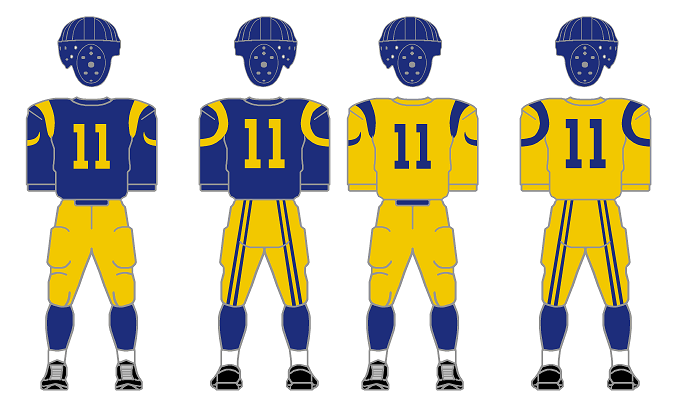
ST. LOUIS – I just couldn’t resist putting ram-horn 'stripes' on the shoulders and reverting to the royal blue and yellow. In the late-1940s, mono-yellow was the look for the Rams. These are easily identifiable as no other team.


SAN FRANCISCO – These are pretty much a set of AAFC-style Niners. I like this flavor of gold better than today’s khaki.


SEATTLE – The original color scheme of Seattle would have never been removed. I made the sleeve stripes to mimic the bi-color pattern of the original Seahawks' logo but made the stripes a single color only and reversed the entire color scheme for the green secondary jersey.

Within this division, it is obvious that the secondary jerseys are quite the necessity. Possessing two teams who have red primary jerseys as well as two teams with blue primaries, the secondary jerseys would get worn every year. Such is the life in the "If Now Was Then" NFC West.

Next week, we wrap up the NFC as we turn to the South...
Bill Schaefer

Twitter

Blog Archive