Showing posts with label Bears. Show all posts

Say It Ain't So, Joe...er, George!

by Bill Schaefer


Many of you, I'm sure, have seen at least parts of the collection of Merv Corning's artwork similar to the George Halas image, and others, above. Mr. Corning was commissioned by the NFL to create the images for the book "The First 50 Years" in 1969. Similar drawings of Ernie Nevers in his Duluth Eskimos uniform and Bronko Nagurski in a psychedelic 1936 Bears uniform have been carved into our collective football souls. But never, never, never, did I believe for a single second that, if by chance one of these famous drawings could be incorrect, it would happen to be the above drawing of "Papa Bear" George Stanley Halas. Recent evidence has turned up that this uniform, very likely, was not worn until the following year (1921), when the Bears Staleys moved to Chicago.

This marks the second time in the last few years that we at the GUD, along with the help of our loyal viewers and contributors, have discovered an erroneous, long-standing misconception of a very early League franchise. If you remember back to October, 2012, our own Tim Brulia penned an article posted on Uni Watch explaining how, despite the claims of the Pittsburgh Steelers, the 'bumblebee' uniform that was made into a throwback jersey that the Steelers have worn the past two seasons and attributed to the 1934 season, had, in fact, only been worn in 1933 (along with the equally detestable 'City Seal' jersey).

As THE Bears fan residing in GUD, it pains me to say that it is extremely, 100% likely that the Chicago Bears organization has NOT always worn navy and orange. "Sacrilege," you say? I couldn't agree more. Up is down. Black is white. Cats and dogs getting along. We're talking the seventh sign of the apocalypse here!

How could this happen? All football fans with a shred of League historical knowledge know how George Halas, a University of Illinois alum, purchased the Decatur Staleys and remade them in the image of his alma mater donning the navy and orange that the Bears have worn for almost 100 years. What we have discovered, with the help of a contributor, identified as "LJP," that no fewer than 6 different articles from the 1920 Decatur Review refer to the Staleys as wearing red (or crimson) jerseys.

Two possibilities exist. The first option is that the reporter for the Decatur Review was color blind and his editor didn't notice any of these 'errors.' The second option, and dare I say the more likely of the two, is that the Staleys actually wore red. In hindsight, I guess we should have seen this coming. After all, since the story goes that he remade the team in the image of the University of Illinois, the Staleys HAD to have been in something else besides navy and orange to necessitate that subsequent change in the first place.

While we don't have enough to substantiate the reason for this discrepancy in the history of the Bears' organization, enough is known that we can assemble a viable postulate for the circumstances surrounding what likely happened over 90 years ago...

In 1920, George Halas moves to Decatur, Illinois, to take a position with the A.E. Staley Company, a starch manufacturer. For the sake of argument, let's assume that the Staley Co. bore red in its logo and the team was supplied with red jerseys. The team takes a financial loss in 1920 despite superior play and Halas buys the team in order to move them to the big city, Chicago. There is a suspicion that a condition of the sale, likely an advertising ploy, is that Halas must retain the team nickname of "Staleys" for one year after moving to Chicago. This would explain the single year of operating as the "Chicago Staleys" in 1921. However, Chicago already boasts a professional football team, the Cardinals, who wear...you guessed it...red jerseys (technically maroon but definitely in the same 'ballpark'). That year Halas refurbishes the team in the navy and orange image of his beloved alma mater, the University of Illinois, in order to appeal to local fans and eliminate any chance for confusion with the Cardinals. With the conditions of his purchase satisfied, in 1922, Halas renames his team the "Bears" because football players are larger than the baseball-playing denizens his team will be sharing Wrigley Field with, the Cubs, thus creating a timeless link between the two franchises. 

There is even a distinct possibility, though unsubstantiated at this point, that the Staleys continued to wear red jerseys early on in the 1921 season before eventually changing colors at some time in midseason but that remains unconfirmed at this point.

Here are the snippets from the Decatur Review that have been brought to our attention...

September 29, 1920

October 3, 1920

October 10, 1920

October 11, 1920

October 25, 1920

December 11, 1920

Because of this preponderance of evidence, the GUD is changing the image for the 1920 Decatur Staleys to a crimson/red version of their jerseys, assuming that the general design was correct and the colors, only, were incorrect. We are, however, holding off on changing the 1921 image to include additional red combinations until such a time as evidence is produced proving that they were, indeed, worn after 1920.


Hopefully, my fellow Bears fans can come to grips with this as I have.

Bill Schaefer

A Head-to-Head History: The Chicago Bears and the Minnesota Vikings


The Minnesota Vikings joined the NFL's Western Division as an expansion team in 1961 and wasted no time making their mark with a surprising upset in their very first game, a 37-13 whipping of their new Western Division rival Chicago Bears in Metropolitan Stadium. Possibly even more unique than their rookie scrambling quarterback Fran Tarkenton was the fact that the Viking's uniforms featured purple as their primary color, the last team to do so was the 1933 Portsmouth Spartans. Tarkenton had a magnificent afternoon in his debut, throwing for 250 yards and four touchdowns against George Halas' normally stout defensive unit that featured future Hall of Fame members Bill George and Doug Atkins. 


Normalcy returned in their second match-up that year as the established team Chicago rolled to a 52-35 win at Wrigley Field. That win set off a period of domination where the Bears record against the Vikings would be 11-2-2, which included and NFL Championship for the Bears in 1963.
Butkus and the Bears captured the 1963 NFL Title, while Marshall and the Vikings
got theirs in 1969, before losing to the Chiefs in Super Bowl IV.
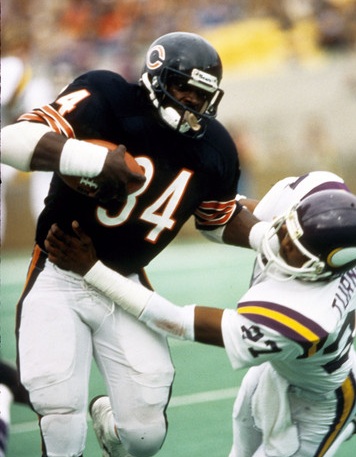
Payton carries against
Minnesota in 1983
In 1984 the Bears emerged as the divisions dominant team and had one of the great season in NFL history in 1985 when the 15-1 Bears ran roughshod over the NFL on their way to a dominant victory in Super Bowl XX. By the time Chicago came to visit Minnesota in Week 7 of the 1986 season, the Bears had won 12 consecutive games, which included six-in-a-row against their divisional foes. The most recent came just two weeks earlier in Soldier Field where the Bears bullied Minnesota quarterback Tommy Kramer with seven sacks in a miserable 11-for-30 performance in a 23-0 rout. Things were quite the opposite in the Metrodome however. Kramer was six for six for 134 yards and two touchdowns in the first quarter, giving Minnesota an early lead and allowing his defense to return the favor on Bears signal caller Steve Fuller with seven sacks of their own. The Vikings out-gained Chicago 263-56 in total yards in the first half as they built a 16-0 lead. The final tally ended 23-7 as the stout Minnesota defense limited Payton to 28 yards on nice carries. The Vikings finished in second place in the division with a 9-7 record but did not qualify for the playoffs. Chicago went on to a 14-2 record but were upset at home in the Divisional Round by the Washington Redskins.
Harbaugh and Ditka get into it in 1992
The division rivals met in Week 14 of the 1994 season with the NFC Central title on the line. The 8-4 Bears and 7-5 Vikings exchanged the lead four times through the first three quarters as the Bears lead 24-16. Warren Moon lead Minnesota on scoring drives for a field goal, then a touchdown capped with a two-point conversion to retake the lead for Minnesota 27-24 with 4:12 remaining. Steve Walsh then lead the Bears on a drive that tied the game with a 33-yard Kevin Butler field goal at 1:55 tying the score 27-27. Butler had a chance to win the game with a 40-yard attempt in overtime but the ball sailed wide left. From their own 35, Moon lofted a pass to Chris Carter at mid-field, who had made a double-move, and outraced the Bears secondary the final 50 yards for the deciding 65-yard touchdown for a stunning 33-27 win.  Minnesota went on to win the division at 10-6 and the Chicago finished second at 9-7. The two met again at the Metrodome in the Wild Card round of the playoffs. Chicago took the rematch with an opportunistic defense, intercepting Moon twice and recovering two fumbles, while limiting the Vikings to only 49 yards on the ground in a 35-18 win. The Bears would lost to the eventual Super Bowl Champion San Francisco 49ers the following week. 
Although most Vikings-Bears meetings were fairly typical uniform-wise, in 2007 in the Metrodome, the Vikings went mono-purple, while the following year they
went retro and the Bears went mono-white...
...and in the second game in 2008 in Chicago, the Bears broke out the Orange Alts...
...and two years later in November 2010, the Bears went retro themselves,
while the Vikings donned purple pants
The Vikings won the next two meetings in Minnesota, while the Bears then won the following two meetings in Chicago.  The second meeting, in late 2010, after a winter storm collapsed the Metrodome roof, was played in frigid temperatures at University of Minnesota's TCF Bank stadium.  It would be memorable for being the final appearance of Brett Favre's career, and the Vikings would lose 40-14.
The arrival of head coach Bud Grant from the CFL and the Purple People Eaters front four featuring Alan Page, Carl Eller, Jim Marshall and Gary Larsen turned the tide of the series. From 1969 through 1983 the Vikings record against Chicago was 22-6. This period included 10 Division Titles and many epic playoff contests with the Dallas Cowboys and Los Angeles Rams. Unfortunately, all four Super Bowl appearances for the Vikings ended with disappointing losses.


In the midst of this Minnesota NFC Central domination, came a record setting performance from a remarkable player. In  Week 10 of the 1977 season the 6-3 Vikings visited the 4-5 bears. Halfback Walter Payton was ill with the flu, but coach Jack Pardee knew his star back was Chicago's only chance against Minnesota's strong defensive front.  Chicago's first play on the cold, damp, windy afternoon at Soldier Field was an end run where Payton charged ahead for 29 yards. The all rush drive ended in Minnesota territory on a failed fake field goal attempt, but Payton would fin the end zone in the second quarter on a one yard plunge, and a Bob Thomas field goal gave the Bears a 10-0 halftime lead. The weather conditions were so foul that Bears quarterback Bob Avellini attempted just one pass in the half, a six-yard completion to Payton, who had 26 carries for 144 yards - an impressive total for a full game! The first Bears possession of the third quarter resulted in a punt being blocked for a Viking touchdown, cutting the lead to 10-7. Both defenses clamped down and yards were at a premium. When the Bears received the ball at their own 20 yard line with 5:38 Payton had 201 yards on 36 carries. After picking up a first down, Payton gained 58 yards on his 38th carry, being tackled at the Vikings nine-yard line. Two rushes and a sack gave Chicago a fourth-and-goal and coach Pardee did not have confidence in a field goal attempt, even from short range. Payton rushed for six and was tackled at the two, giving him 275 yards, breaking O.J. Simpson's record of 273. The Bears defense held on for the victory, evening Chicago's record at 5-5. Both teams finished the season at 9-5. The Bears qualified for the post season for the first time since 1963 but lost to Dallas in the Wild Card Round. Minnesota won the Central Division, defeated the Rams in the Divisional round but lost to the Cowboys in the NFC Championship Game.


One of the series most unforgettable moments occurred in the fourth quarter of a game at the Metrodome in October 1992 with Chicago nursing what seemed like a comfortable 20-0 lead. Bears quarterback Jim Harbaugh had played well, leading four scoring drives, throwing for a touchdown and running for another. On a first down he called an audible, but telegraphed a pass that was intercepted and returned for a touchdown. Coach Mike Ditka was apoplectic, and met Harbaugh on the field, screaming, cursing and gesturing wildly. After the game, Ditka did not back down, and told the press, "I'll just say this...if it happens again, there will be changes made and they will be definite and they will be permanent. I'm not going to put 47 players' futures in the hands of one player who thinks he knows more than I do." The sudden change in momentum was palpable. The Chicago offense stagnated, gaining only two first down the rest of the way, while the Minnesota offense capitalized. Quarterback Rich Gannon was a perfect 7-7 in leading two touchdown drives to complete the improbable comeback. This was the beginning of the end for Coach Ditka in Chicago. The Bears struggled to a 5-11 record, their worst in a decade. The Vikings won the NFC Central title with an 11-5 mark but exited the playoffs in the Wild Card round with a loss at home to the Washington Redskins.


Chicago and Minnesota had a memorable meeting in 2007 when the teams traded scores six times in nine possessions during a back-and-forth, fourth quarter scoring barrage.  The Vikings broke a 14-14 tie with a 73-yard touchdown run by rookie Adrian Peterson in the third quarter (who had also scored from 63 yards out in the second quarter.) and extended the lead to 24-14 following a Ryan Longwell field goal at the start of the fourth. Chicago answered with a field goal on the next possession to cut the lead to seven, but Petersen swept around left end from the Bears 35 and raced for his third touchdown of the game to extend the Minnesota lead to 31-17 at 4:20. Brian Griese had a deep pass intercepted, but the Bears defense bailed him out by forcing the Vikings to go three-and-out.  A three play 53-yard drive finished with a Griese-to Mushing Muhammed touchdown cutting the Viking lead to 31-24. The onside kick attempt failed, but the Vikings again went three-and-out, punting the Bears deep. On second-and-ten, Griese lofted a deep pass to Devin Hester, who caught the ball at the Chicago 35, juked a defender and raced into the end zone for the tying score to complete the 81-yard play at 1:49. Peterson returned the kickoff 53 yards for Minnesota, setting the Vikings up at the Chicago 38. After three plays netted just one yard, Longwell was good on a 55-yard field goal attempt, the longest of his career, for the 34-31 Vikings victory, their first in Chicago in seven years. Peterson finished the game with a Minnesota club record 224 yards rushing on only 20 carries.


Special teams played a pivotal role for the Vikings in the 2008 Soldier Field meeting, but this time it was to the Bears benefit. Chicago scored twice on punt plays, but surprisingly neither involved return ace Hester. With the game tied 7-7 in the first quarter, Chris Kluwe bobbled the snap and had his punt blocked. Kluwe illegally kicked the ball a second time while it was on the ground right to defender Garret Wolfe who returned it 17 yards for a touchdown (second picture above). Midway through the second quarter with the score tied at 17, Viking returner Charles Gorman had the ball bounce off his leg inside his own 10 yard line, which Chicago's Zackary Bowman recovered in the end zone for the touchdown. The back-and-forth scoring continued through the half and third quarters, which included a 51-yard touchdown catch by Marty Booker. After a one-yard rush by Matt Forte opened the lead to 17 points, Minnesota attempted a comeback attempt. Gus Frerotte lead the Vikings to a field goal and touchdown to close the gap to 48-41, but with a chance to tie the game his final pass was intercepted and the Bears ran the clock out. The 41 points were the most Chicago has ever surrendered in a victory.  


Last year, the 8-8 Bears swept the 3-13 Vikings, winning in October on Sunday Night Football at Soldier Field and again in Minnesota for the season finale in December.  The 2012 Bears are 7-3 and are reeling having lost two straight primetime games with QB Jay Cutler being injured.  Cutler should be back today, but the Vikings are revitalized this year behind QB Christian Ponder and at 6-4 are in the thick of the NFC Wild Card race.  In just two weeks these two teams will meet again in the Metrodome, possibly with the Division title on the line, although the 7-3 Green Bay Packers also figure to have in say in that as well.

The Problem With The Internet


The Problem With The Internet
by Rob Holecko

The problem with the internet is you can't always believe everything you see, even when the source is somewhat reputable.  Yesterday we unveiled a new feature here at The Gridiron Uniform Database called "On This Day..." where we will feature past games played on this calendar day from now through the Super Bowl.  In researching today's December 17 game, we were preparing the head-to-head matchup of the 1933 NFL Championship game, and in stumbling upon the Pro Football Hall of Fame's website we came upon this picture and caption to the right, purported to be the 12/17/33 NFL Championship game between the Giants and the Bears at Wrigley Field.
Not "On This Day..."
Not so fast, my friends!  After consulting with the other two-thirds of the staff, our Bill Schaefer and Tim Brulia told me that this picture is indeed not from that game.  The grandstands, they told me, indicates that that game appears to be at the Polo Grounds, therefore is it probably from the 11/19/33 regular season game between the same two teams.  After further research, I came across this contemporary picture from the Pittsburgh Press via Google News, that indicates that yes, the Bears did wear white in that game:


But what about the other picture?  Well apparently the folks at the Hall of Fame believe it is from the Championship Game, and because of that other people on the internet believe that it is true, and they blog about it, and the error gets compounded.  (Note: after the publishing of this article, Keith Yowell, author of 'Today In Pro Football History,' whose comment you can read below, updated his site and corrected the picture to the above actual image from the 1933 NFL Championship Game. Special thanks also to Tom Farley for bringing our research to Keith's attention. All any of us want is accuracy. Now if only the Pro Football HOF can correct their information, we'll be all set!).  

Nonetheless, as our research shows, the Bears did wear white in that game, and the picture from the HOF (and elsewhere) on the internet was not from that game.  It just goes to show that you shouldn't assume anything on the internet is entirely accurate without double-checking it yourself, no matter what the source is, even if it is the Pro Football Hall of Fame.  Here at the Gridiron Uniform Database, we'll always strive to bring you the most accurate facts and whenever we do uncover new information, we'll bring it to you and update accordingly.

Speaking of which, sometime in the new future, we'll be bringing you some new discoveries about these mid-1930s Giants, thanks to our head researcher Tim Bruilia, working with "bigbluelarry", our friend Larry Schmitt.  Without further ado, the "On This Day..."

On This Day...

The NFL split into Eastern and Western divisions in 1933 and the Chicago Bears and the New York Giants were the division champions and met in the first ever scheduled Championship game on December 17.  These teams met in November, the aforementioned game at the Polo Grounds, which the Giants won 3-0.  This rematch was an exciting game full of trick plays and exciting action with players such as Bronco Nagurski and Red Grange, and the Bears held on to win 23-21 and claim their third NFL title.  You can read in-depth write-ups of the game here, here and here (just remember the pictures may not be from the correct game!)

Both of these 1933 Giants-Bears matchups have been added to our 'matchups database,' and if there is a game you'd like to see in there that hasn't been added yet, let us know and we'll get to it. We'll be back tomorrow with another past NFL matchup, another game with an exciting memorable lateral and what a surprise, it features the Buccaneers again! 

Don't Move My Number


     Today here at The Gridiron Uniform Database we have a few new changes to update, as well a discussion about the proper placement of Steelers' shoulder numbers, or as they have also been called, "TV numbers".

~ ~ ~


     In the late 1950s and early 1960s, when NFL games were first being televised regularly, teams added numbers to the sleeves, to help the viewers at home identify players when they were at the line of scrimmage or the front or back numbers were otherwise un-viewable.

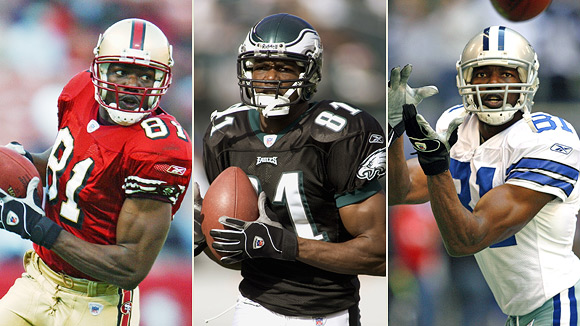
     Most teams that have these shoulder numbers have traditionally placed them either way up high, on top of the shoulder (like these in the Terrell Owens pictures), or down low on the sleeve, like the Colts do in this picture of Peyton Manning.  So that is how we have depicted these numbers, either on top of the shoulder, or down on the sleeve.

     It has come to our attention, however, that the Pittsburgh Steelers' 1968-96 uniforms (along with apparently some years of the St. Louis Cardinals) employ a third option, which places the numbers somewhere in between, right around the apex of the shoulder.

     While we had considered this before, in the words of our graphical engineer, Bill Schaefer:

"...if we put the numbers 'right there,' there'd be no way to make them look right. One of the limitations of the 2-D template is, along with the omission of helmet numbers, that TV numbers MUST be placed on the shoulder pads facing up or on the sleeves. I was never able to crack 'wrapping the one' from the top down around to the side and make it worth it."

     Numbers in this location, even more so than in the higher or lower locations, don't always appear in the same place on all players:


     Says Bill: "...Franco's numbers are clearly facing up on his shoulder pads. If Swanny or Terry had any kind of shoulders, their's would likely be facing upwards, too."

     So for the time being, that project was shelved, and we were content to just depict the numbers on the top of the shoulders (right), after we were unable to find a suitable location to more accurately depict them.  But with some help from The Jeff in the forum, we have decided to take another shot at this.  Here are six options that Bill and the guys have come up with as to how we could depict these numbers better.  Your input and feedback in the comments below will be most welcome.


Which graphical Steelers sleeve number representation do you like best?
123456


~ ~ ~

     We have added to the database the memorial arm sleeve that the Chicago Bears wore for their December 23, 1979 NFC Wild Card playoff game at Philadelphia in memory of George "Mugs" Halas, Jr., who died of a "massive heart attack."  Halas was the team president and the son of Bears' founder George "Papa Bear" Halas.   Another change we have made is to the 1961 Giants, we have removed the white center stripe on two red-striped pants model and replaced them with the matching grey on all eight versions of the '61 Giants.
     Finally, with the 1968 and '69 Vikings, we have made some adjustments to the uniform numeral, and the proper depiction of the "one".  Thanks to bigbluelarry (Giants) and Mako Mameli (Vikings) for these submissions.
1979 Chicago Bears
1961 New York Giants
1968 Minnesota Vikings

~ ~ ~

     Tomorrow we'll mark one week since we've launched the website, and we'll tell you all about some of the most surprising websites that have referred traffic to us, including one website that isn't even in English.  And beginning Monday, we'll start a five-part series looking back and discussing the past uniforms the Buffalo Bills have worn, as they get ready to launch their new look on Friday.

Stripe Colors

     The Minnesota Vikings, Carolina Panthers, Baltimore-Indianapolis Colts and Jacksonville Jaguars team pages are in, meaning we're at thirteen and only three away from being halfway done with having all of the team pages in.
     A couple updates to the database, the 1937 and 1938 Chicago Bears now have orange stripes on their socks instead of white in the database.

It's hard to tell in black & white pictures what color things are sometimes
     Look at the three shirt sleeve stripes on the players in the picture to the left.  They are navy-orange-navy.  Notice how light the orange appears in black-and-white?  So you can see why it's hard to tell white from orange on the sock stripe.
~ ~ ~
     Coming Thursday, a major announcement here at the Gridiron Uniform Database about our new permanent home on the web, as well as a gripping discussion of "grip strips," as worn by teams like the Brooklyn Dodgers in the early 1930s.

Twitter

Blog Archive

Tags