Showing posts with label Rams. Show all posts

New Uniforms of 2020

In addition to all teams (other than the Bears) reverting to the NFL Shield at the bottoms of their V-collars, seven teams have made 'significant' changes to their uniform for the coming 2020 season.

As the graphics artist for the GUD, I usually have to look at uniform reveals through a different eye. "You mean I gotta draw THAT?!?"

Additionally, where a team has shown what combinations of jersey, pants, and socks they plan on wearing during the season, I like to be prepared.  I assemble every possible combination eliminating the need to miss Sunday football because someone decided to put together a strange new pairing that no one expected and I need to assemble it.

Atlanta Falcons
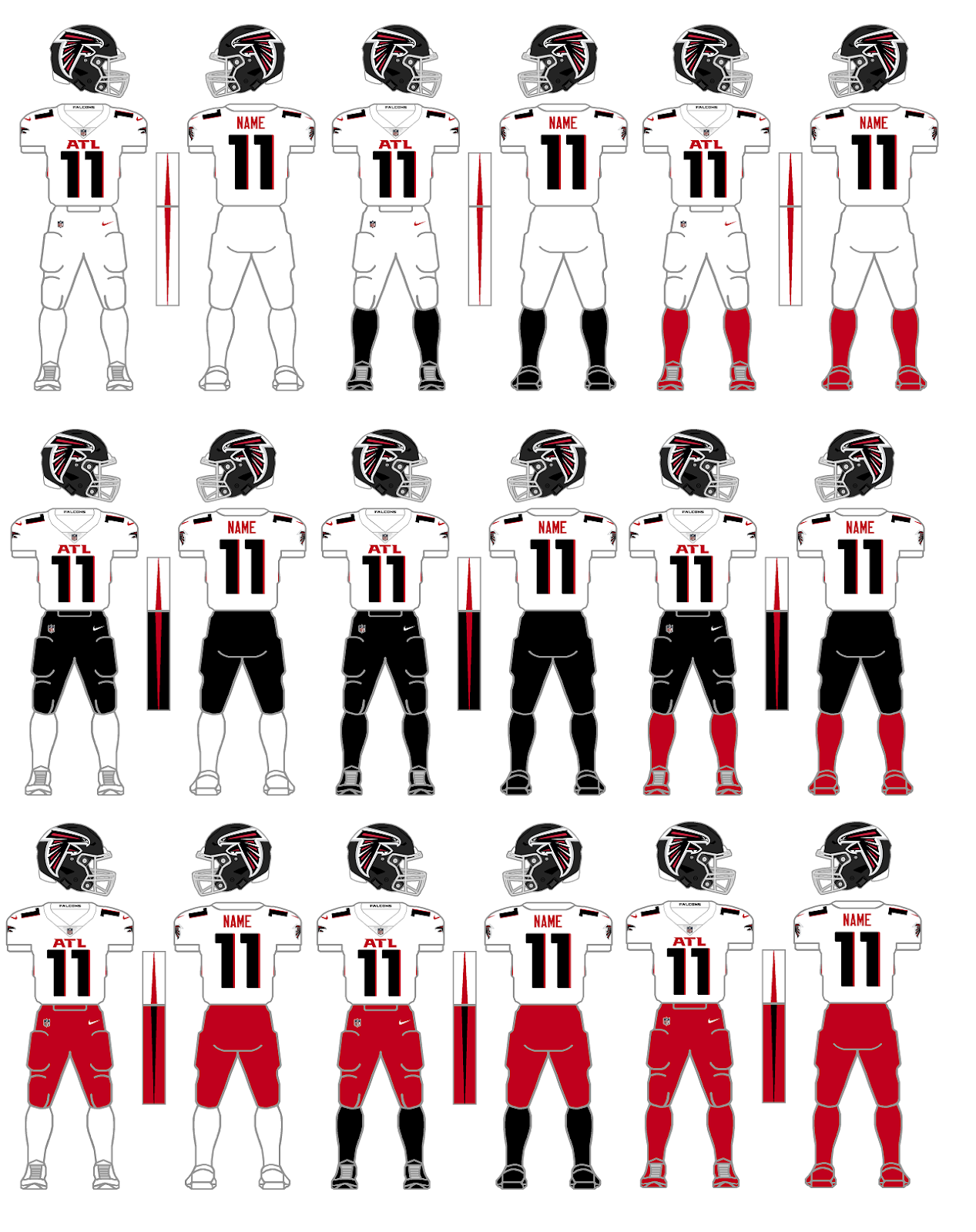
White Jersey combos
This is a great place to start because this needs to be said and it's best to do it right off the bat. Teams need to stop matching socks and cleats. In their uni-release, only a single red-pants combination was proffered - white jersey, red pants/socks/cleats - found above in the lower right corner. I don't like any of these red pants combinations. The foremost reasons are the fact that the pants stripe and jersey side panel stripe conflict with each other and the red pants completely conflict with the black helmet when having only white in between. I'm not a fan of all-white uniforms either but the black socks and red socks combos with the white jerseys and pants in the top row would work for me as long as the Falcons wore white shoes. I'm not really a fan of any of the black pants combos in the middle row.
Bottom line: Don't match pants, socks, and cleats. Contrast is needed.

Black Jersey combos
As for the black jersey combos, let's start by eliminating all three of the white socks combos down the left side as well as the bottom right corner again with red pants, socks, and cleats. All four of these are simply bad looks.
My favorites are the two black jersey and white pants combos with the colored socks - again assuming the Falcons go with white cleats. The all-black in the center is passable but my favorite is in the middle of the bottom row - black jersey, red pants, black socks and cleats.

We knew that the Falcons were likely keeping their 'throwback' uniform although they were forced to use it with the new matte-black helmet. Not really a big deal.
However, as 'the art talent' here at GUD, let me tell you...there are two things I can't stand - sublimation patterns and gradients. Here is the first "You gotta be kidding me" of the new season. The really bad news is that I kinda like the gradient combo. I just hope that it doesn't create a trend of more teams going with this kind of look.

Overall, I don't mind what Atlanta did. With the exception of the gradient uniform, they really went minimalist and that's OK. The matte black helmet doesn't bother me although I do think the over-sized helmet logo is comically big and after all, isn't just a tip of the cap from the Falcons to their divisional-rival Buccaneers saying "We like what you did with that big flag on your helmet. Take a look at our big bird!" The one thing I really wish they'd correct is the big ATL on the chest. The over-sized numbers would look better if they didn't have to be squeezed into view along with the big, honkin' "ATL."

Cleveland Browns
White Jersey combos
Cleveland ownership listened to their long-suffering fans and got rid of one of the great uniform monstrosities ever perpetuated in the League ranking right their with the 2014-19 Bucs, 2013-17 Jaguars, and the 2002-10 Bills. A little known fact about Browns uniforms is that the Browns tend to match socks with jerseys. However, every once in a while, the Browns would throw a curve ball at us and wear brown socks while wearing white jerseys. It could happen so I planned on being ready. The two combos to the left are likely what we will see for most Cleveland road games this season. One thing I don't care for is that the Brown pants need a white stripe between the two orange stripes. I know these are essentially their Color Rush pants from past seasons. but to be worn as part of a normal rotation with these new uniforms, they need the white stripe.

Brown Jersey combos
I just mentioned the brown pants being last year's Color Rush pants and missing the white middle stripe. To top that off, it appears the Browns kept the all-brown Color Rush combo but removed all stripes. Basically, the Browns said we need two sets of brown pants. The Browns love their brown pants apparently, but does everyone out there remember what Deadpool said about the brown pants? My apologies for the brief, graphic violence but I couldn't resist. Children get your parent's permission first...https://www.youtube.com/watch?v=KKC0jN-GfhA.

After they released their new uniforms, the Browns announced that they got some negative feedback from fans because they did not include options with orange pants. Congrats to the Browns. They gave their fans what they wanted to see with these retro new uniforms. The lack of orange pants was an oversight. The team admitted the error, and stated that they'd find a way to get the orange pants. Kudos. These looks are the Cardiac Kids that I remember from when I was a youngster. There's something just so right about these two looks. I hope we get them frequently this year.

Indianapolis Colts

The most notable change that the Colts are making is the re-shaping of their horseshoe as seen above. Other less notable changes include changing the Nike 'swooshes' on their white jerseys (and likely their white pants, too) from blue to black. Why? The Colts added a logo to the inside of their collars that may or may not have been plagiarized from an Indiana high school team (but I'll let the courts decide that). The Colts also returned to a number font used in their early days. However, because of our use of the number 11, the change won't be noticeable since the ones will be the same for both the new and old number fonts.

Los Angeles Chargers
White Jersey combos
Go ahead, I dare you to find something wrong with these uniforms. Nit-pickers could say something like "There are no TV numbers." Or "the bolts on the pants don't have enough zig-zags." These people need to get a life. I admit that I am getting tired of the italicized number fonts and would have preferred a nice, old-fashioned block font, but I digress. Hmm. I guess I was able to find a 'negative.'

Powder Blue Jersey combos
Personally, I think the Chargers should do something like only wearing the yellow pants either for all of their day games or for all of their night games, some kind of gimmick like that.

Alternate Blues combos

I like the all-royal but it seems superfluous with the all-navy. I really hope the Chargers actually wear white shoes with the all-navy combo. White helmets and white shoes would book-end the uniform nicely. I wonder of the Chargers field-tested the navy uniform with the numbers hollowed-out, as well. Probably made the numbers too difficult to read though.

One other thing...if the NFL ever does do away with the 'One-helmet Rule,' in the words of my daughter, I think this would look 'sick' for night games...

Los Angeles Rams
Bone & Blue jersey combos
The Rams became the last team to unveil their new uniforms. I believe that these blue and bone jersey combos must be evaluated together as one group.

First, let me say that I have no problem with the helmet. Over the years, many fans have been bothered by the fact that the Rams' helmets always had a navy shell that clashed with the royal of the their usual uniforms. That has been corrected with a brilliant, metallic, royal blue shell. The logo is new and different. It's not great. It's just different and I'm sure we'll get used to it. At least they didn't use the gradient coloring on the helmet logo!

Honestly, the jerseys are my biggest problem with these uniforms. The glossy piping of the numbers would have looked better as just regular fabric. This was too big of an attempt to be 'glitzy.' The fold-over-the-back-of-the-collar logo tags are gimmicky. The jerseys would have looked better if they just slapped the logos right on the collar - inside and out. The contrasting look of the tag on the bone jersey is superior to the blue-on-blue tag on the royal jersey. That one would have looked better had it been a yellow tag. The collarbone 'patch' and the peculiar zig-zag stitching limited to just a small portion in the upper right corner is just stupid.

But my biggest peeve for these jerseys is actually the 'sleeves.' The blue jerseys have the Ram horns. The bone jerseys have some kind of wave or shark fin. Why would you not simply put the Ram horns on the bone jerseys also? That makes no sense.

And you already know my feelings about gradients. My question is why not have two blue jerseys. One would have the gradient numbers to be worn with the gradient-striped pants as a Color Rush combo. Another blue jersey without gradient numbers could be worn with the yellow pants. The gradient numbers look unusually out of place when worn with the yellow pants.

New England Patriots
OK. I'm taking bets. I'm willing to bet that this is the last time that an NFL team has a new uniform reveal and only reveals two combinations.

I like what they did. I like the red-blue-red stripes on the white jersey. But at the same time I still agree with those that say its too much red in a blue-oriented jersey. A blue-red-blue stripe pattern probably would have been better.

Like the Browns, the Patriots left the door open to possibly add white or silver pants in the future. I got one for you. What about red pants? Those could be a worthwhile option with the white jerseys.

Tampa Bay Buccaneers
The Bucs pulled a 'Browns' and simply went back to something that works. They never should have moved away from this design in the first place. While keeping a large helmet logo, the Bucs still reduced the logo considerably. Now, instead of being 'freakishly large,' now they have a logo that's just 'big.' The Bucs also ditched the bling-bling chrome grill. Good. Grills are for cars and patios, not football helmets. I would like to see the new Color Rush uniform worn with some red socks and white cleats. 

So who will be getting changes for next season, in 2021? Cardinals? Bengals? Broncos? Eagles? I guess we'll have to wait. Hopefully there will only be two more months before we start thinking about preseason games.

Bill Schaefer
GUD

Matching Rivals: Chargers & Rams

Royal blue and yellow, perfect colors to represent southern California, evoking images of the Pacific Ocean and abundant sunshine. It's not surprising that the professional football team residing in Los Angeles and San Diego chose to adorn their teams in these colors for significant portions of their respective histories. For 11 seasons spanning 1974 - 1984 the two teams looked remarkably alike.

The Rams were born in Cleveland, and moved west in 1946, bringing their royal blue and yellow uniforms with them. Yellow was the color of their primary jersey through most of the 1950's. However, they were difficult to distinguish from opponents wearing white on black-and-white TV's, so they made the switch to blue jerseys with yellow numbers and Northwestern stripes on the sleeves. Yellow was nearly absent on the white away uniforms, only being seen on the famous horns on the helmet and center pants stripe. That trend continued to the extreme in 1964 when yellow was abandoned altogether during the Fearsome foursome era of Deacon Jones and Merlin Olsen.

In 1973, following an ownership change, the Rams completely redesigned their uniforms. Not only did yellow return to prominence, but the entire design was ingenious. The iconic Ram horn from the helmet was incorporated onto the shoulder of the jersey. The effect from the front view was similar to the over-the-shoulder UCLA stripe, but the horn continued around the back of the sleeve, encircling the TV number. On the white jersey the horn was blue and the sleeve was yellow. The Rams wore this jersey in their near upset of the Pittsburgh Steelers in Super Bowl XIV.

The Chargers are most well known for their white helmet and powder blue jersey from their AFL years. However, for fans of the Air Coryell era of the late 70's and early 80's, the images of Dan Fouts carving up secondaries are somewhat different. They got there in part by drawing inspiration from a longtime NFL franchise.

Sid Gillman (who played for the Rams while they were in Cleveland and coached them when they were in Los Angeles) was an admirer of Vince Lombardi and the success he achieved in Green Bay with the Packers. Given that yellow was already in the Chargers color scheme (seen in the Air Force Acadamy inspired arced lightning bolts on the helmet and inside the UCLA stripe-like jersey stripes over the shoulder), Gillman's changing the Chargers white pants to yellow in 1966 was easy. In 1973 the numbers on the blue jersey changed from white to yellow.

The first major change to the Chargers uniforms occurred in 1974, and it included an alteration to their familiar color scheme. Gone were the powder blue jerseys and white helmets, replaced by the royal blue worn by their neighbors to the north. Creating even more synergy with the Rams was the absence of the lightning bolt on the Chargers pants. They instead featured a basic blue-white-blue stripe pattern, which was identical to Los Angeles. The Chargers also sparked a revolution of sorts with their new uniforms - they were the first team to paint their facemasks in a team color instead of going with the manufacturer's stock grey. By the turn of the decade most teams followed suit, which included the Rams changing theirs to blue in 1981.

Though they played regularly during the pre-season, because the two teams played in different conferences, they only met on the field twice between 1974 and 1984 during the regular season.  They met in 1975 in San Diego, and then again in 1979 in Los Angeles in a game in which the Rams wore white at home, so both times the Rams wore their white jerseys and the Chargers royal blue. Confusion among fans in the cheap seats of the Los Angeles Coliseum or Jack Murphy Stadium trying to distinguish the two teams would certainly been understandable.  That 1979 Rams team went on to Super Bowl XIV, while the following years the Chargers made it all of the way to hosting the AFC Championship Game, where they lost to the eventual Super Bowl XV Champion Oakland Raiders.

San Diego made slight diversions when they switched from solid blue socks to blue stripes on white in '78, and reintroducing the lightning bolt returned to the pants in '79. In 1984 the lightning bolt was set inside a solid blue stripe.

While the Rams uniform remained unchanged for the duration of their stay in Southern California, the Chargers continued their journey away from their powder blue roots. In 1985 they returned to white pants, but darkened their tone of blue to navy. The next season yellow took a further step back when the numbers on the blue jerseys became white. Two seasons later San Diego was outfitted in their starkest contrast ever: an even darker tone of navy with white lighting bolts on the helmet and jerseys, and plain striped pants. No one could ever confuse the Chargers for the Rams again.


~ ~ ~ ~ ~


In our next installment we'll take a look at two silver and blue teams who crossed paths several times during the late 60's and early 70's, including a postseason contest in which neither team scored a touchdown.

Super Bowl XIX


Super Bowl XIX
by Rob Holecko

Twenty-seven years ago today, on January 20, 1985, the San Francisco 49ers defeated the Miami Dolphins in Super Bowl XIX 38 to 16.  It was Joe Montana and the 49ers' second Super Bowl in four years, and it was a very memorable game.  It was played in Stanford, California, the closest a team has ever come to playing a Super Bowl in it's home stadium.  It was the first Super Bowl televised by ABC.  President Ronald Reagan, on the day of the inauguration of his second term in office, conducted the coin flip from the Oval Office.

As for the game itself, from Wikipedia:
Instead of the predicted shootout between Dan Marino and Joe Montana, the game was mostly one-sided. The 49ers defense only allowed 25 rushing yards and 16 Dolphins points. San Francisco also intercepted Marino 2 times and sacked him 4 times. The Dolphins set a Super Bowl record for least rush attempts in a game (9).

But in the opening minutes of the game, it seemed that the game would live up to the hype. On the opening kickoff, 49ers rookie kick returner Derrick Harmon caught the ball too close to the sidelines and stepped out of bounds at the San Francisco 6-yard line. The 49ers managed to advance to the 41-yard line but were forced to punt, and Dolphins defensive back Fulton Walker returned the punt 9 yards to the Miami 36-yard line. Then on their first play of the drive, Marino completed a 25-yard pass to Tony Nathan. Five plays later, Miami reached the San Francisco 23-yard line. But on third down, 49ers cornerback Eric Wright tackled wide receiver Mark Clayton 2 yards shy of the first down. Miami had to settle for a 37-yard field goal from Uwe von Schamann.

The Dolphins' 3-0 lead did not last long, as the 49ers stormed down the field on their next possession. San Francisco drove 78 yards in 8 plays, culminating in a 33-yard touchdown pass from Montana to reserve running back Carl Monroe to give them a 7-3 lead. But Miami retook the lead on their ensuing drive. After a 5-yard rush by Nathan, the Dolphins went into a no-huddle offense, preventing the 49ers from making substitutions and keeping their run defense on the field. Marino completed five consecutive passes, hitting Clayton for 18 yards, Mark Duper for 11, Clayton again for 13, and tight end Dan Johnson for 21. On the next play, Marino finished the drive by hitting Johnson for a 2-yard touchdown pass, giving the Dolphins a 10-7 lead with 45 seconds left in the first quarter.

In the second quarter, the 49ers began to take control of the game. Bill Walsh switched to a 4-1-6 (or dime defense) to slow down Miami's passing attack, with Keena Turner as the sole linebacker. Miami tried to run against the 4-1-6 alignment, to no avail. Safety Dwight Hicks broke up two consecutive Marino passes, and the Dolphins were forced to punt from their own 10-yard line. Then after taking the ball at the Miami 47-yard line, Montana scrambled for a 19-yard run, and then completed a 16-yard pass to wide receiver Dwight Clark to reach the 12-yard line. From there, Wendell Tyler rushed for 4 yards, and then Montana threw an 8-yard touchdown pass to Roger Craig, giving the 49ers a 14-10 lead.

Miami then had to punt again on their ensuing possession, and San Francisco defensive back Dana McLemore returned the ball 28 yards to the 49ers' 45-yard line. After advancing 15 yards with 2 running plays, Montana completed a pair of passes to tight end Russ Francis to move the ball 29 yards to the Miami 11-yard line. Craig ran for 5 yards on the next play, and then Montana ran the final 6 yards to the end zone for a touchdown, making the score 21-10. After the ensuing kickoff, Miami again was forced to punt after 3 plays, and McLemore returned Reggie Roby's 39-yard punt 10 yards to the 49ers' 48-yard line. Montana was sacked for a 5-yard loss by Doug Betters on the first play of the ensuing drive, but he struck back with a 20-yard completion to Craig and a 7-yard run over the next two plays. On the next play, wide receiver Freddie Solomon caught a pass from Montana, took one step, and then lost the ball due to a hit from safety Lyle Blackwood. Blackwood quickly recovered the ball and took off for the 49ers end zone, but field judge Bob Lewis blew the play dead, ruling that Solomon's fumble was an incomplete pass. Bill Quinby, the side judge, who was nearest to the play, did not make any call. Five plays later, Craig finished the nine play, 52-yard drive with his second touchdown on a 2-yard run, increasing the 49ers lead to 28-10.

With about two minutes left in the half, the Dolphins finally managed to get a good drive going on their next possession. Marino completed 7 out of 9 passes, the last one being a 30-yard pass to tight end Joe Rose, to reach the 49ers 12-yard line. But San Francisco's defense tightened up on the next 3 plays, forcing 2 incompletions and a completed pass for no gain, and Miami was forced to settle for Von Schamann's second field goal of the game to cut their deficit to 28-13 with 12 seconds left in the half. Then Miami caught a break as the 49ers botched the ensuing kickoff. San Francisco lineman Guy McIntyre received Van Schamann's short kick and was about to down the ball, but then changed his mind at the last second and decided to return it. This turned out to be a big mistake. McIntyre lost a fumble while being leveled by rookie Joe Carter, and Jim Jensen recovered the ball for Miami at the 49ers 12-yard line. After that, Von Schamann kicked his third field goal on the last play of the half, cutting the score to 28-16. "I can laugh about the play now, but it wasn't funny at the time," McIntyre said after the game. "My first instinct when I got the ball was to fall down. Then I heard everyone yelling, 'Get up! Get up!' So I got up, and here comes someone sneaking underneath me, and he hit the ball."

But any thoughts of a Miami comeback ended early in the third quarter. On the first play second half, 49ers defensive end Dwaine Board tackled Nathan for a 1-yard loss. Then after Marino threw an incompletion, Board sacked him for a 9-yard loss on third down. For the fourth time in the game, Roby had to punt, and again McLemore gave the 49ers good field position with an 8-yard return to San Francisco's 47-yard line. The 49ers then drove 43 yards and scored on kicker Ray Wersching's 27 yard field goal. On the Dolphins' ensuing drive, they were forced to punt again after Marino was sacked twice (once by defensive lineman Manu Tuiasosopo and once by Board). Starting their own 30-yard line after a 5-yard return by McLemore, Montana completed a 40-yard pass to Tyler, followed up with a 14-yard completion to Francis. Three plays later, Craig scored his third touchdown on a 16-yard reception to make the score 38-16. The score proved to be the last one from either team, as the defenses of both teams took over for the rest of the game - especially the 49ers' defense, who intercepted Marino twice.

Overall, San Francisco gained a Super Bowl record 537 yards, breaking the Oakland Raiders record of 429 yards in Super Bowl XI, while limiting Miami to 314, with just 25 rushing yards. San Francisco's 38 points also tied a Super Bowl record set by the Raiders in Super Bowl XVIII.

The 49ers' 288 offensive yards in the first half also tied the Raiders in Super Bowl XI for the most offensive yards in a half during a Super Bowl.

Marino finished the game with 29 out of 50 pass completions for 318 yards, 1 touchdown, and 2 interceptions. Clayton was the top receiver of the game, with 6 receptions for 92 yards. Walker returned 4 kickoffs for 93 yards and gained 15 yards on 2 punt returns. Nathan was the Dolphins leading rusher with 18 yards, while also catching 10 passes for 83 yards.  Craig had 58 rushing yards, 77 receiving yards, and 3 touchdowns. He was the first player ever to score 3 touchdowns in a Super Bowl, and his 2 touchdown catches also tied a Super Bowl record. Tyler led San Francisco in rushing with 65 yards, and also caught 4 passes for 70 yards. Clark caught 6 passes for 77 yards. Board recorded 2 sacks. McLemore recorded 51 punt return yards, the second most in Super Bowl history.
We are proud to add this game to the Gridiron Uniform Database.  Also today we are launching a new page today, the index of Super Bowl Matchup graphics.  As we add Super Bowl matchups to the website today, you'll find all of them here, you'll see a new link on the front page.  We'd like to thank Mark Young, who a few months ago designed our new banner graphics, for putting together the roman numeral graphics on this page.

Also on this day, five years previous to Super Bowl XIX, the Rams and the Cowboys met in Super Bowl XIV.  This was the game that saw the Steelers put the cherry on the top of their 1970s dynasty, winning their fourth Super Bowl in six years.

~ ~ ~

Another On This Day... that we'd like to mention.  Yesterday was January 19, and while there has never been a Super Bowl on January 19, we would like to recognize a particularly memorable game from nine years ago.  As a Buccaneer fan, while I realize that the Super Bowl victory over the Raiders is definitely the crowning achievement of our franchise, it was Ronde Barber's interception return of a Donovan McNabb pass for a touchdown that clinched the NFC Championship against the Eagles, that was the moment from that season that was most memorable.  After having lost at Philadelphia in the playoffs the past two seasons, after having never won a game below forty degrees, to go into Philadelphia and win that game to go to the Super Bowl, was really the best moment ever for the Bucs in their 35 years of existence.


Two Championship Tilts


"On This Day..."
by Rob Holecko

We hope everyone had a good Christmas, a least a better one that the ex-boyfriend of this girl at Lambeau Field last night. (see picture to the right)

Yesterday while discussing the 1971 Christmas Day 'longest game ever' between the Chiefs and the Dolphins, we mentioned that twice previous, the NFL had scheduled NFL Championships for Monday the 26th, rather than play on Christmas Sunday.

Today we will feature those two games, the 1955 and 1960 Championships, for our "On This Day..." feature.

In 1955, the Los Angeles Rams, in coach Sid Gillman's first season, were the Western Division champions at 8-3-1.  They had won the 1945 NFL championship while still in Cleveland, and the next year moved out west to Los Angeles.  Out west they had gone to three straight championship games from 1949 to '51, winning a second championship in '51.  Now under Gillman, with players such as Bob Waterfield and Elroy "Crazylegs" Hirsch, they were back in the title game, looking for their third title.

Meanwhile the team that replaced them in, or some would say drove them out of, Cleveland, Paul Brown's Browns, the defending champions, were in their sixth consecutive NFL Championship in six years in the league.  After winning all four AAFC titles from 1946 through 1949, the Browns were 1950 and 1954 NFL Champions, and arguably one of the best dynasties of all time, going for their seventh title in nine years.  Led by Otto Graham, Lou Groza and Dante Lavelli, the Browns were 9-2-1 and Eastern Division Champions.

Here is the Wikipedia write-up of the game:

The 1955 National Football League Championship Game was played at the Los Angeles Memorial Coliseum between the Eastern Conference champion Cleveland Browns and the Western Conference champion Los Angeles Rams. The 23rd NFL title game was played on Monday, December 26, 1955 before 87,695, the largest crowd to see an NFL title game to that time. This was the first NFL championship game televised by NBC and the first NFL championship game played on a Monday.

Browns veteran Lou Groza kicked off; Rams rookie halfback Ron Waller returned the kick, and Groza himself made the tackle. A subsequent Rams drive was stopped at the Cleveland 12 when Kenny Konz intercepted a Norm Van Brocklin pass. Browns quarterback Otto Graham, who had announced his retirement at the end of the season, drove Cleveland to the L.A. 26 where Groza's FG gave the Browns a 3-0 first quarter lead. The Browns scored again when DB Don Paul intercepted Van Brocklin's pass on the Browns 30 and raced 70 yards to a touchdown, making the score 10-0. The Rams answered back when Van Brocklin connected with halfback Volney Skeets Quinlan for a 67-yard rouchdown, pulling the Rams to within 3 points, 10-7, and giving the large crowd hopes of an upset. But late in the second period, Van Brocklin threw his third interception of the half; defensive back Tom James, who had been beaten on the Rams' Tom Fears' title-winning touchdown on the same field four years earlier, grabbed the errant pass and took the ball back to midfield with time running out. The next play turned a close game into a rout; Otto Graham found Dante Lavelli with a 50-yard TD pass along the sideline and the Rams, who moments earlier were driving to take the lead, went to the locker room down 17-7.


Graham earned his place as the star of the game. After moving the Browns from the L.A. 46, Graham kept the ball and ran around right end from the 19 and scored to put the Browns ahead 24-7. On Los Angeles's next possession, Sam Palumbo intercepted Van Brocklin at the Ram 36. Graham drove the Browns to the 4, then scored himself on a sneak. Groza's conversion increased Cleveland's lead to 31-7 with two minutes left in the third quarter. In the final period, Graham tossed a 35-yard touchdown pass to Ray Renfro and Groza's kick gave the Browns a 38-7 lead. Late in the game, Waller ran four yards for a touchdown and Les Richter's conversion finished the scoring. In the final minutes coach Brown sent in reserve quarterback George Ratterman and allowed Graham to leave the field to an ovation from the Los Angeles crowd. Cleveland, winning three titles in the first half of the decade and representing the Eastern Conference in the championship game every year since its admission to the NFL, celebrated Graham's farewell, while the Rams' Van Brocklin, who threw six interceptions, would often be quoted that the game was the worst of his Hall of Fame career.
This may have been the pinnacle of the Browns' dynasty, while they would go on to have five more conference titles from 1957 through 1969, including a 1964 NFL Title, their fourth NFL title and 8th overall, after the 1970 merger, the Browns would never see the greatness of the 1940s and 1950s.  After a couple heart-breaking AFC Championship losses to Denver in the 1980s, the Browns' would move to Baltimore after the 1995 season.  Although they would re-born as a 1999 expansion team, the current incarnation of the Browns has only been to the playoffs once, in 2002, and continues to rebuild, ever in search of recapturing they glory days of yesterday, and along with the Detroit Lions, are the only non-expansion teams to have never reached the Super Bowl.
The Rams, like the Browns, have not seen success in recent years like in the olden days.  While they were a perennial playoff team, reaching the postseason 14 out of 17 years from 1973 through 1989, they continuously ran into strong Cowboys and Vikings teams in the 1970s and Bears and 49ers teams in the 1980s and only made it to one Super Bowl, losing XIV to the Steelers after the 1979 season.  Under Kurt Warner and Marshall Faulk, they reached two Super Bowls, winning XXXIV after the 1999 season and returning two years later.  They too, have reached bottom again, won only 3, 2 and 1 games from 2007 through 2009, and are currently completing another 2-win season.

The other championship game we are looking back to today is the 1960 championship between the Packers and the Eagles.  The Packers (8-4, Western Conference Champs) were just beginning their 1960s Vince Lombardi years of greatness, while the Eagles (10-2, Eastern Conference Champs) led by Chuck Bednarik were the dominate team in the league that year.  While they would go to two Super Bowls, winning NFC titles in 1980 and 2004, the 1960 squad would be the last Eagle squad to be NFL Champions.  They went to four straight NFC Championships from 2001 to 2004, and again in 2008, but are still looking for that elusive title, having celebrated the 50th anniversary of the 1960 Championship by wearing throwbacks to that year Week 1 2010.

The Packers, of course, were the team of the 1960s, rebounding from this loss to the Eagles to win the 1961 and 1962 titles, and three more from 1965 through 1967, as well as the first two Super Bowls.  After a couple decades of mediocrity, they would win Super Bowl XXXI under Brett Favre, and another one last year under Aaron Rodgers, and are working on a second this year.


We are proud to add these games to Gridiron Uniform Database's collection of randomly added single-game matchups.

You can view other randomly added past games here.

Back When A Bucs' Primetime Game Was Exciting

For those of you who watched the Bucs dismal performance on NFL Network against the Cowboys last night (not talking to those of you who have Time Warner or Bright House) it may seem like a long time since the Bucs played an exciting primetime game.  Earlier this year the Bucs beat the Colts on Monday Night Football, and while a win is a win (and was much better for Buccaneers' fans than the historical 2003 MNF collapse to the same Colts) it was a boring game.  But if we go back eleven years to a Monday Night game between the Bucs and the Rams, you will recall one of the most exciting primetime games in recent memory, as we go... "On This Day..." back to 2000:


"On This Day..."
On December 18, 2000, the Bucs and Rams played a thrilling Monday Night game, so good in fact, the fact that Dennis Miller was announcing it didn't even detract from it.  In the crowded NFC playoff chase, the two teams from the previous year's NFC Championship met in a game they both needed.  The winner would clinch a spot, while the loser would be in danger of missing the playoffs altogether.   Trailing 35-31, with under 2:00 to play, RB Warrick Dunn caught a screen pass and was wrapped up fifteen yards behind the line of scrimmage on a key third down and it seemed like the Bucs hopes were dwindling.  Just before being whistled down, however, Dunn lateralled the ball back to QB Shaun King who improbably ran thirty yards for a first down, and the Bucs drove down the field for the winning score.

The Bucs went on to miss a field goal on Christmas Eve at Lambeau Field the following week and had to settle for a wild card, where they lost to the Eagles, and the Rams beat the Saints the next week and made the playoffs anyway, but then lost to the Saints in the first round.  The Rams made it back to the Super Bowl the next year, losing to the Patriots, while the Bucs (after another wild card loss to the Eagles after the 2001 season, fired Tony Dungy and hired Jon Gruden and got their Lombardi trophy the following year.)  But for one exciting December night in 2000, these two teams played an epic MNF battle.

To read a complete recap of the game, click here.


We are proud to add this historic Monday Night football game from eleven years ago today to our matchup database.
~ ~ ~

Speaking of yesterday's dismal Bucs-Cowboys game (well, dismal if you are a Bucs' fan anyway), what was up with the bias on the NFL Network's coverage?  While this was the fourth consecutive year that the Cowboys have been on NFLN's Saturday Night special broadcast, this was the first time the Bucs have ever been on NFL Network, I believe.  It would have been a perfect time for them to showcase the Bucs.  I know they are playing awful -- in the midst of a seven-game (now eight-game) losing streak, but that was no excuse for the bias-ness of the NFL Network's coverage.  Yesterday on their network they aired, leading up to the game: "America's Game: 1992 Cowboys", "America's Game: 1995 Cowboys", a replay of the Cowboys-49ers game from earlier this year, "Tom Landry: A Football Life", and Top Ten Dallas Cowboys of All-Time.   C'mon, is this a national network, or am I watching a local Dallas-Fort Worth station?  They could have at least mixed in an "America's Game: 2002 Buccaneers" instead of 10 straight hours of this Cowboys-love fest.  The game was all-Cowboys, at least they could have shown the Bucs a little love during the programming all day leading up to it.  Even FOX News thinks that violates equal time guidelines!  Even ESPN is less biased when showing a Red Sox-Yankees game!

And then to top it all off, they rubbed salt in the wound at halftime, the Bucs were trailing 28-0, and they put the Bucs' score not just as "0", but "00":


What, one "zero" wasn't enough?

Twitter

Blog Archive

Tags