Matching Rivals: Browns & Bengals


We are starting a new feature here at the Gridiron Uniform Database today.  Earlier this year, you'll remember that Larry Schmitt profiled for us each of the new inductees of the Pro Football Hall of Fame's class of 2012.  Beginning today Larry is back with a new feature, and he'll be taking a look at throughout the summer -- every two weeks -- instances where NFL teams have had very similar looking uniforms...here's Larry:

~ ~ ~

In today's modern NFL, there are a wide variety of uniform styles and themes that serve as a treat for the eye every Sunday. Most teams see their uniform as a way to identify themselves on the field and as a means of connecting to their fanbase. From the enduring traditional looks featured by the Chicago Bears and New York Giants to the modern, trendsetting styles of the Denver Broncos and Tennessee Titans, to the just plain weird of the Seattle Seahawks. Throw in the occasional alternate jersey or throwback uniform, there's something for every fan to enjoy.

There have been instances in history where teams have blurred the lines as bit as to their identity. Similarity in color and striping patterns, particularly in the 1960's and '70's, at times may have left fans watching wondering just which side they were on. We'll take a look at these match-ups and try and lend a historical perspective to see just how things may have turned out this way.

First up: Ohio rivals Cleveland and Cincinnati.

~ ~ ~ ~ ~~

Paul Brown "The Father Of Modern Professional Football" was an NFL innovator the likes of which will never be matched. He was the first coach to introduce film study (using the All-22 high endzone view) into regular practice, invented the Screen Pass to maximize the talents of Otto Graham and Marion Motley, standardized the 40-yard dash as a measure of a football players ability to cover punts and kickoffs, and even pioneered helmet radios to get call in to his quartebacks decades before technology caught up to his genius.
One other feature he brought to the pro game that is mostly likely overlooked by most fans - Brown introduced orange (his favorite color) as a primary helmet color for two two unique franchises.
The Cleveland Browns of the AAFC wore white leather helmets for four seasons. Up[on joining the NFL, they added orange leather helmets to their ensemble for night games. Making the switch to hard plastic shells in 1952, the Browns helmets were orange forevermore. A single white center stripe was the lone feature, until brown player numbers adorned the sides from 1957 - 1960. In 1960 brown stripes were added, and 1961 the side numbers removed. The old, reliable Cleveland Brown helmet has been the same ever since, even after it's creator Paul Brown was relieved of duty following the 1962 season.
The basic uniform also saw relatively minimal changes over this period. Usually favoring white jerseys at home (while most NFL teams would wear their primary colored jerseys) Cleveland had plain, dark brown block numbers with contiguous 5-stripe sleeves and socks, alternating brown-orange-brown. Their white pants had contiguous 3-stripe pattern of orange-brown-orange.
In 1968 Paul Brown returned to Professional Football as owner and head coach of the AFL expansion franchise Cincinnati Bengals. It was no coincidence that the new team looked an awful lot like the one that had been named after the Ohio coaching legend. In fact, the substitution of black for dark brown as the primary jersey color and a stripe-free helmet were the only real differences. If one were to just glance quickly, it would be understandable to mistake them for the Browns.
Following the AFL-NFL merger, the intra-state rivals met on the field for the first time on October 11. Fans in the cheap seats of Cleveland Municipal stadium may have had a hard time telling the opponents apart. The Browns continued with their white-at-home tradition, forcing the visiting Bengals to wear their black jerseys. The Browns may have inadvertently made a move to looking like their Cincinnati counterparts the year before. In 1969 Cleveland made the first ever alteration to their sleeve and sock striping pattern when they went from the contiguous pattern to an offset one. The Bengals themselves switched back-and-forth between their 3-stripe sleeve patterns between the contiguous and offset versions during the early '70's.
The rematch in Cincinnati later that season saw the Bengals going white-at-home, meaning Cleveland's brown jerseys would make a rare appearance. The same was true for 1972, with both teams wearing their whites at home. For the 1973 and '74 match-ups, Cleveland continued with white at home whole Cincinnati returned to the traditional primary colored jersey at home, so all four meetings saw the same uniform sets displayed.
In 1975 the Browns made a drastic move that helped distinguish them from their rivals - orange pants. In 1981 the Bengals move even further in that regard, when they retired their conservative, traditional look for the tiger striped helmet still in use today. Ironically, Paul Brown himself said when asked about the design change, "you couldn't read 'BENGALS' from a distance. When you were far away it looked like Cleveland's helmet."
In two weeks we'll feature two Southern California teams with colorful uniform histories - the Chargers and Rams - who looked like near replicas of one another for a 10 year stretch in the late 70's and early 80's.

Timmy B returns from Canton


Last week, May 15th and 16th, I spent two days of research and touring the facilities at the Pro Football Hall of Fame in Canton, Ohio.  As reported last week in this space, my objective was to find as much information as possible regarding uniforms worn by National Football League teams from our missing uniform era of the Gridiron Uniform Database (GUD), 1920-1932.
I had said that I had no idea how (un)successful I would be.  As it turns out, I was able to track down roughly 30% of the uniforms of the era.  My most successful season was probably 1931, where it looks like I found information on 6 of the 10 teams that season.  My least successful season would have to be 1924, where I was only successful in nabbing 2 of the 18 teams.

Jon Kendle, Researcher at the Hall, was more that kind enough to assist me with the project. All day on the 15th, he dug through the photo archives of the Hall for the team photo files for the 1920-1932 years.  I had to wear a pair of white gloves as I sifted through the files in search of these ancient pictures.  The files were listed by team.  There were also negatives mixed in with the available photos.  Alas, many of the files were empty.  But still, I was able to gather a lot of information.  Unfortunately, I was not allowed to take pictures of the material that I sifted through.  However, I was able to log descriptions of the photos as best as I could.  In due time, we hope to bring you the results on the GUD.


I also went back on the 16th to finalize my findings, and came across a couple of surprises.  We hope to include these as well in the coming days and weeks.  I thanked Jon for his help and then I did a tour of the Museum itself.  It's $21 for a tour of the facility.  I took as many uniform-themed photos as I could, most of which accompany this blog.  Two interesting items of note: One was the "Super Bowl Experience" where there was a "tease" of training camp footage from years past and the 2011 season, with some regular season footage from the 2011 season up to the Conference Championships.  Then we entered the theater for a 25 minute feature from NFL Films, exclusively for the Hall, of Super Bowl XLVI.  It was done as only the creative geniuses at NFL Films could provide.  The seating at the theater was movable.  We saw all of the stuff of the lead-in to the Big Game and when it was time for kick-off, the seating area moved from one screen to another.  The exit led us to a display of all 45 Super Bowl rings.  Talk about bling!


The other item of interest came near the end of my tour.  A couple of volunteers lugging around a large trunk happened by where I was taking a break. They said, "Are you here for the helmet presentation?" As I muttered "no," they said, "Too bad!!"  They opened the trunk and pulled out about 10 helmets, some very old, some reproduced and some that were experimental.  It was an enlightening 15 minutes of the history of the pro football helmet, from when it was just a thick woollen cap, to a projected model that was still on the drawing board, that featured safety features to deter concussions as much as possible.

The Hall is undergoing yet another expansion that will culminate next year, to coincide with the Hall's 50th anniversary.  It is worth the while of any football fan, to visit this facility.

Getting back to the task at hand.  To be honest, because of the rather ship-shod way that the NFL kept track of things before 1933, and based on my research last week, it will be a most monumental task to have a complete database of uniforms from before 1933.  I think it could be possible to have complete years back to maybe 1928 or so.  But beyond that...

Still, we think this will be a great step forward as we go backward more in time.  Again, I wish to thank the staff, volunteers and Jon Kendle at the Hall for all the courtesies extended to the GUD.

To view all of Tim's pictures from the Pro Football Hall Of Fame trip, click here.

Timmy B goes to Canton

On May 15th, I will be on the road before the crack of dawn to make a 6 hour drive to the mecca of Pro Football, the Pro Football Hall of Fame in Canton, Ohio.

Once I arrive at the shrine, I will be getting right to work to document as much as possible over a two day stretch as many uniforms as possible of the teams that played between our missing years on the Gridiron Uniform Database between 1920 and 1932.

To be honest, I have no idea how (un)successful I will be in this endeavor.  The research that I have done from 1933 through roughly 2003 has come from on-line newspaper archives, on-line photography databases like gettyimages, AP images, and of course, frequent journeys to the Pennsylvania State Library in Harrisburg and the Library of Congress in Washington.  However, the research for the "B.C." era of the National Football League will have to come from such a place as the Hall of Fame.  As I researched the 1933-1940 years, photographs from game action shots became more of a hit or miss thing.  They were there, but not in the quantity or quality of 1940 to date newspapers.  Without question, pro football game action photographs in newspapers prior to 1933 will be minimal, if not altogether lacking.  Add to the fact that so many small cities dotted the NFL landscape in the '20-'32 years, like Pottsville, Rock Island, Portsmouth, Duluth, Hammond, Dayton, etc.  And access to newspapers that served these smaller cities would be - apart from travelling to these communities in person - virtually impossible.

So, the best alternative is to make the trip to Canton and make use of the Hall's research facilities.  I have used them once before.  It was in May of 2006 when I was on a similar mission to unearth the TV commentator crews for NFL games from the 1968 - 1982 era, after the TV team specific commentators era (e.g. Ray Scott and Tony Canadeo doing Packers games for CBS) and before the debut of the USA Today newspaper, which immediately began to chronicle all of the week's TV crews.  I was moderately successful with the key sources for that information coming from the teams' game notes distributed to the working media.  This assignment though, will make exclusive use of visuals.  It is said that the Hall has the most extensive collection of pro football photographs in the world.

Without question, all of the photographs I will find will be black and white.  Fortunately, through Wikipedia ("always with a grain of salt") and ColorWerx, a very reputable website specializing in team/college colors, I have been able to track colors for all of the pre-1933 squads, except for the Louisville entries.  My plan is to hone in on the team group photographs that are in the Hall's collection.  I will try to document as much info as I can find on whatever I come across.  One item of personal relief is that in probably 90%+ of the time, I will not have to worry about helmet colors or pants colors.  The earliest instance that I (currently) know of a team coloring its helmets would be the c.1931 Chicago Bears, who used a Michigan "wing" style of helmet with their familiar navy and orange colors.  As for pants, the move from a natural canvas khaki-type color to team specific colors didn't start to trend until the early-mid 1930's.

From the limited number of pre-1933 team photographs I have seen, a typical photo will show the great majority of players in matching uniforms, but then several players will be wearing something different. Normal these variations might include friction (or grip) strips on the front, or some type of contrasting color material that is stitch into the ribcage portion on the jersey.  While I will document this in my research, I am not fully certain that we will list these variations in the Gridiron Uniform Database.  It must be noted that the NFL and their teams were very much on a limited budget and thus could only have enough money to outfit maybe a dozen or so players in one style, and then shop the Salvation Army or other surplus stores for spares. 

Whatever my findings, I will report in a follow up blog later in the week.  Hopefully the venture will be a success. I can't really say at this point what I consider a "success", but usually if even just one morsel of knowledge is gained from the journey, than I personally will think the trip worthwhile.

Stay tuned and wish me luck!!

Gridiron Uniform Database Goes HD

As the 'art' man for the site, I would like all of you to know the plans for the coming season.

I've already been hard at work for the last month working on the new NIKE uniforms. I've been doing what I can with the little information I have. Paul Lukas' notes from NIKE's unveiling were immensely helpful.  I'm still not sure why we didn't get an invite! However, through no fault of Paul's, little information has been provided on each team's 'other jersey(s).' I've had to reference NFL Shop to try and grab some peeks at the white-jerseys for each team to confirm or refute whether changes exist or not.

With the exception of a few alternate/throwback jerseys that I'm pretty sure we'll get to see, and others that I'm even more sure about (like the Bears moth-balling the orange jerseys in favor of using the 1940 throwbacks again - right), there are some that I'd just rather wait for firm confirmation of before I try to put each into graphic form only when it becomes apparent that I really need to.

The other issue that I am unclear about and am still awaiting confirmation on is whether or not the NFL is doing away with the whole 'base white/base black' footwear requirements in light of the very flashy cleats that were showcased with the rest of the uniforms last month.

Despite that, I have been working hard with our webmaster Rob Holecko to fine tune our game plan for this coming season. While we don't foresee wholesale changes, changes will be made - hopefully you will see them as a good thing.

Rumors abounds on the interwebs
that this is Carolina's new helmet.
Source: nikeblog.com
(But it's not)
If you've stopped by the site recently, you may have noticed that Rob has put up a blank/generic template for the Opening Game of the 2012 Regular Season.  The thumbnail image includes the new Nike template for both teams. We decided that, despite teams like Green Bay and Philadelphia opting not to partake in the technology advances of the Nike Elite, we will keep things simple by using only one version of the blank template for all teams. The template also shows a new, modified helmet. We at the Gridiron Uniform Database decided that this change from Reebok to Nike was a perfect opportunity to change away from a moderately outdated helmet model to something more current.


If you click on the blank thumbnail an image will appear that is the same size as what you've come to expect from Gridiron Uniform Database. However, due to the detail of the work involved with new cuts, collars, and (Lord, help me) new numbers with ingrained patterns (Thanks, Seattle and Nike - grrr!), we wanted to try to present the uniforms from this year additionally in a much crisper fashion.


Clicking on the normal-sized versions will take you to a larger version that will enable you to see the intricacies of the uniform in much greater detail.

More: from Seattle Post-Intelligencier: Seahawks unveil new helmet
Additionally, on the 'normal-sized' matchup pages, you will be spotting new navigational tabs for "Opening Games," "Monday Night Football," "Thanksgiving Day games," "Super Bowls" and more

It is our hope that you will find this year's graphics even more vibrant and realistic than ever before. Enjoy.


The Gridiron Uniform Database mourns the passing of Junior Seau and extends condolences to the entire NFL family.

Junior Seau
1969-2012

One-Time 1953 Colts Lid Confirmed


One-Time 1953 Colts Lid Confirmed
by Rob Holecko

Last week in our forum a visitor asked us about our depiction of in the database, the "cross style helmet" worn by the Baltimore Colts in their inaugural season in Baltimore.  In fact, this was their first game in Baltimore ever, as they moved from Dallas and were the Texans in 1952.  The previous "Baltimore Colts" entry in the league, which was absorbed into the NFL from the AAFC in 1950 along with the Cleveland Browns and the San Francisco 49ers, was unrelated to this franchise.

The visitor, identified not by a name, but simply by the moniker "Frizz's All Helmets" asked about the existence of this helmet:

Is there any pictures of the 1953 Baltimore Colts Cross Helmet available. Trying to collect all mini helmets and have not found any evidence of this helmet. I don't want to go through the trouble of making this helmet and it is false.

Our Bill Schaefer responded:

It was worn for Baltimore's (version 2.0) first inaugural game on 9/27/53 when they hosted the Bears during Week 1. After this game the cross stripes were removed for the following 7 weeks that they wore white helmets. Additionally, on 4 occasions during the season, Baltimore wore blue helmets instead of the white ones. Tim uncovered this on one of his research trips to the Library of Congress but was unable to take with him a copy of the photographic evidence.

I am glad to announce that through additional research, we have procured a copy of the photograph of this helmet as it ran in the September 28, 1953 Chicago Tribune.
We are glad to be able to bring this data to you, and also happy to provide FAH with the photographic evidence he requested.

However this brings to light an important question regarding our research.  Everything we have listed in the database is there because Tim Brulia, our historian, certifies it is correct to the best of his knowledge.  As we get further back in time, a lot of our research is by necessity incomplete.  There are some games from the 1920s and 1930s that simply we will never see photographs of.

As Tim generally says, if you have photographic proof that something we have is wrong, we'll change it.  But what about as we go further back and we have to fill in the holes between confirmed data with merely educational guesses?  This is an issue that won't be solved overnight, but calls for a definite spelled-out policy as we begin to tackle the 1921-1932 era.  How will a visitor be able to tell the difference between a graphic that we have confirmed versus one that we are merely presenting as our "best educated guess."  I want the future Frizz's All Helmets that come to our site to know that if they see a graphic as listed as being worn by, for example, the 1925 Pottsville Maroons whether it is something we have confirmed, or merely an "educated" guess that we are going with in absence of more concrete evidence to the contrary.  Surely we can't provide photographic evidence of every single game ever played -- that's what our graphics are for.

If we see pictures from twelve of a teams' thirteen games in 1926 and see the same jersey, sure we can assume that they wore that same jersey for the unseen thirteenth game. But without confirming, we still can't say that they absolutely did wear that jersey. We can be 99.99999% sure that that's probably what they wore, but it's not the same thing as being definite. As we move further back in time, we'll let you know exactly what our policy is and how you will know that a game has been "photographically confirmed" or just an assumption.

This is what the Baseball On The Nines'
says the 1923 AL Washington squad
wore in 1923.  I guess we'll just
have to take their word for it.
I understand Frizz's reluctance to accept a graphic of ours as fact.  In fact I feel the same when I view other uniform databases on the web, such as the Baseball Hall Of Fame's Dressed To The Nines website.  I view things on there with a grain of salt.  I look at a graphic on there and I don't think of it as "that's what the Washington Senators wore in 1923"... I look at it as "that's what the Dressed To The Nines website says the Washington Senators wore in 1923."  There is a slight and subtle difference, but it is what it is.  Without referencing the newspaper photograph, our reputation is the only thing that (before viewing that photograph) that proves that the Colts actually wore that helmet.  For some people that isn't enough.   But until our policy changes, it's the best we can do.

But rest assured at the Gridiron Uniform Database, whatever you see in our database is correct*, whether the proof is transparent and available for you to see, or you're just taking our word for it.  (*-But if it isn't let us know, and we'll change it.)


Steelers vs GUD, Part II - BucTracker Weighs In


Further Evidence Supports The GUD Over The Steel City Gridders
by Rob Holecko

Yesterday we told you how the Steelers' new "1934" throwbacks which were unveiled by the organization may not have been actually wore on the field by the Pirates during that season.  Today we received further research from GUD's friend and frequent contributer, the BucTracker himself, Jerry Wolper.  Jerry sent us some photos from the Pittsburgh newspapers backing up our claim that the Steelers did not wear the alleged jersey during the '34 season.

Exhibit 1:

From September 10, 1934:  (Cincinnati Reds at Pittsburgh Pirates, 9/9/34)


Notice the horizontal striped socks players - those are the Pirates.  No stripes on the jersey of #33.  The ball carrier does not have the striped socks - he is a Cincinnati player.

Exhibit 2 --

From September 17, 1934:  (Boston Redskins at Pittsburgh Pirates, 9/16/34)


 Obviously the dark jerseys with the indian heads are the 'Skins.  Again, no jersey stripes or numbers-in-squares on the Pittsburgh players, but the diagonal pants stripes are there.

Exhibit 3 -

From November 19, 1934:  (Brooklyn Dodgers at Pittsburgh Pirates, 11/18/34)

Again, the light players with the horizontal sock stripes are the Pirates.  Notice the NW stripes on players (specifically 18, 20, 44, 11).  Also notice the vertical pant stripe, but also no sign of the throwback jersey unveiled yesterday.

Jerry also sent along a pic from opening day 1933 game -- the Pirates first game ever -- against the New York Giants.  It shows the city-crest jersey, as well as a discrepancy we had with the '33 Giants -- the number is placed on the jersey a little different then we had it.

As our Tim Brulia said about the Giants discovery:

"...looking at that first pic from the very first game where the Pirates are clearly wearing the city seal jersey, the Giants are DEFINITELY wearing a jersey with contrasting torso band and shoulder inserts, with front and back numbers "half in/half out" of the torso band. I remember this pic from my research of several years ago at the PASL. BUT, I did not notice the shoulder/torso inserts. Since the inserts appear lighter than the jersey color, I am hunching that the inserts are blue on a red jersey.

As we are fond of saying, the GUD is always a work-in-progress!!"

Stay tuned for changes to the 1933 Giants as well as possible adding the diagonal pants stripes to the 1934 Pirates -- however, the "1934 throwback" unveiled yesterday is now more than ever, definitely from late 1933.

Steelers vs Gridiron Uniform Database. Discrepancy? Who's right?


Steelers' 19341933 Throwback Unveiled
by Rob Holecko


Hmmm.  Interesting that the player modelling the jersey is wearing number 33,
considering the jersey was actually worn in 1933.


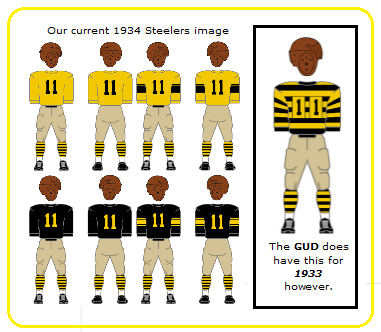
     At 4:30 PM Tuesday afternoon, the Pittsburgh Steelers announced during a live videocast at Steelers.com, the new throwback uniforms that they will be wearing this fall.  Owner Art Rooney II (pictured above with a player modelling the uniform) announced that they would be wearing a design originally worn by the team in 1934.  The jersey shown has black numbers (front and back) inside of white rectangles, on top of a black and yellow alternating horizontal stripe pattern.  They are paired with khaki pants, and yellow socks with black stripes.  Apparent on the 2012 throwback version is the Steelers' 80th anniversary patch as well as the ever ubiquitous Nike swoosh on both the jersey and the pants.


     Currently in the Gridiron Uniform Database, we have for 1934 a more basic design, while we do have a version with the number-in-rectangle design for 1933, although we had the background color for that rectangle as yellow.  Clearly more research will be needed in this area.

     So do we at the Gridiron Uniform Database take this as proof that the Steelers did indeed wear this?  Are they infallible just because they are the organization in question?

     In short, do we take their word for it, or do we insist on further photographic evidence?  As we get further back, in particular as we look towards trying to tackle the 1920s, actual photographic evidence will be harder and harder to come by.

     Here at the Gridiron Uniform Database, accuracy is our number one goal.  If and when we can say with certainty that the Steelers did in fact wear this jersey uniform during the 1934 season, we will update it accordingly.  For now, we will be content saying without a doubt only that they will be wearing this throwback in 2012.

     Regardless of what year they are from, what do you think of these anyway?


Added at 6:00 PM EST.....I just saw in Uni Watch comments someone posted a link to this 1934 Pirates team photo on eBay, it also has the players wearing this jersey... (Although of course a team could be wearing the previous year's unis in a team photo which may have been taken before the season started.)


Added at 6:10 PM EST...  Further searching on the internet turned up this: (at http://morevintagefootballautographs2.webs.com/runningbacks.htm)


The player in question Warren Heller, did in fact only play on the Pirates in 1934 through 1936, and was not on the 1933 squad.  This is backed up by his entry at Pro-Football-Reference.com.  But this football card, however, has the numerals with a yellow background, not a white one.

Apparently the official company line of the Steelers, that they wore the 1994 throwback design with the vertical stripes and the city crest logo in 1933, and the one we saw unveiled today in 1934, very well may be true.

Our historian Tim Brulia, however, begs to differ:
The best research for proof would lie in looking through 1933 and 1934 newspapers. Pittsburgh had three daily newspapers in 1933 and 1934; the Post-Gazette, the Press and the Sun-Telegraph. I dug as best as I could through all three some years ago at the Pennsylvania State Library in Harrisburg. Based on what I could find (which wasn't easy), the Pirates started the [1933] season wearing the city seal jerseys (which inspired the 1994 throwbacks) and then around mid-late season went to the 2012 throwbacks.
My research indicated that the 1934 jerseys were plain with no striping until later in the season when the Pirates put Northwestern stripes on the sleeves. 

The team photo that states "1934" for the Pirates very likely is from 1934. BUT, I have a good hunch that the picture is likely from training camp and was never worn during the 1934 regular season by the Pirates. Black and white photography from this era will be difficult as the yellows (or golds if you prefer) came across as quite dark, in some cases almost as dark as black itself.
So there you have it... our best research indicates that the 2012 throwback unveiled today, was never actually worn in a game in 1934.  As our Bill Schaefer put it: "Looks like the Steelers fell victim to that old 'yearbook' shot/ team photo that said 1934 but was 1933's picture. They shoulda checked our site first!" (Note: Technically it was a 1934 picture, as Heller was in it who didn't join the Steelers until 1934, but it was taken apparently before the season with players wearing the previous years' jerseys.  Note that some of the players in the picture did not have numbers yet, which would seem to led credence to it being a "pre-season picture" -RH)

We would love to see a verifiable photograph from a 1934 game showing this jersey was worn in a game prove us wrong.  Until then, we'll stick to our assertion that the jersey unveiled today was worn actually worn on the field only in 1933.

But what about the Warren Heller football card pic?  Surely since Heller didn't debut until 1934, that must prove that the jersey was worn then, right?  We asked Tim about that and he said: "Again likely, taken from a possible publicity shot in 1934, prior to the start of the season."  Added Bill:

The Warren Heller card - why are we so hung up on the card? It's not like it's an actual photograph like cards in the 70s forward. They did have these people called 'artists' back in the 30s as well. All they had to do was take Heller's face and draw it on the uniform from 1933. If it is a card for 1934, they likely wouldn't have used a shot (uniform) from 1934. That would have appeared on the 1935 cards. Even recent years work that way. When the 2012 cards come out, they'll have shots from 2011.
What we really need to find are football cards from the 1935 series to see what teams wore from 1934.

There you have it.  For now we'll stand by our assertions that the Steelers are mistaken.  The jersey unveiled today was not worn by the Steelers during the 1934 season.  If any further research uncovers anything to the contrary, we at the Gridiron Uniform Database will update it accordingly.

This picture from the 9/10/1934 Pittsburgh Post-Gazette of the Pirates home opener against the
Cincinnati Reds, may or may not back up the Gridiron Uniform Database's assertion that the Pirates did not
actually wear the jersey in question during the 1934 season.


The Early AFL - NOBs or NNOBs (Uni Watch)


By Phil Hecken
(originally published at Uni Watch)

If you’ve been following Uni Watch for any amount of time, you know that on the weekends I enjoy highlighting the many research projects undertaken by UW readers, many of which are the first (and sometimes only) such documentation of important uniform history on the interwebs. On May 8th of last year, the “launch” of the Gridiron Uniform Database was first detailed on Uni Watch. The project is the remarkable collaboration of Tim Brulia, Bill Schaefer, and Rob Holecko.

We began with Bill’s Story, continued with Tim’s Story, and concluded with a third part in which Tim & Bill got together with Rob to take the Gridiron Uniform Database to its own home on the net. Many of you read and enjoy the Gridiron Uniform Database (database and blog), and it is still the go-to source for pro football uniform history.

But as with all historians, Tim & Bill were not satisfied. It had been a long-held belief, as explained below, that the American Football League, which began as competition to the NFL in 1960, featured teams with nameplates (or “Name on Back – NOB”) from the outset (or at least from the beginning of the AFL’s regular season). It turns out that this is not the case — in fact, it’s not just an isolated incidence here or there, but was in fact a league-wide phenomenon.

And so, I turn this over to Tim Brulia and Bill Schaefer, who bring us yet another wonderfully researched dissertation on the AFL NOB:


~~~
 

A little more than a month ago, we at the Gridiron Uniform Database blogged about a commonly mis-held notion by most pro football fans and historians regarding the American Football League’s team uniforms. Specifically, that the AFL eight charter teams kicked off in 1960 mimicking the innovation earlier that season of baseball’s Chicago White Sox by placing the players’ names on the backs (NOBs) of their jerseys just above the numbers.

Our blog stated that this was definitely NOT the case. We cited and showed several examples of where one or both teams did not have NOBs in game action. We were certain of a few teams that would eventually added the NOBs during the course of the season, but we weren’t sure exactly when the teams in question added the NOBs. Five or so weeks of intensive digging followed, first by Bill, then a little later by Tim. After discussing our findings with one another, we at the Gridiron Uniform Database believe we can can share with all of the Uni Watch faithful and our Gridiron Uniform Database followers, for the first time anywhere (as far as we know), a full chronicle, first by team and then by week, of the evolution of the placement of NOB’s during the course of the 1960 AFL season.

First off, are the three teams who stayed consistent for the entire season.

The Los Angeles Chargers wore NOB’s for the entire 1960 season on both sets (white and blue) of jerseys.

The Denver Broncos (also here) and New York Titans did not wear NOB’s for the entire 1960 season.
Now, the four teams that began the season with no NOB’s, but added them during the 1960 season, with the week the nameplates were added:

Buffalo Bills: The Bills opened the season with nameless jerseys for the first six weeks. The NOB blue jerseys debuted with a home game against the Oakland Raiders on October 23rd. They would not break out their NOB white away jerseys for another three weeks until their next road game at Oakland (well, against Oakland at Kezar Stadium in San Francisco!) on November 13th.

Dallas Texans: Lamar Hunt’s Texans went the first seven weeks of the season nameless. After a bye for week 7, the Texans started their NOB era with a road game in Denver on October 30th, confirmed by a photo found in the Library of Congress microfilm collection of the Denver Post. After another white NOB jersey tilt in Buffalo for week 9, the Texans wore red NOB’s for the first time on November 13 in the Cotton Bowl against the Broncos.

Houston Oilers: This was the one team that Bill and Tim had a hard time firming the handle on. After some discussion, it was determined that the Oilers started the NOB era with their home game at Jeppesen Stadium in Week 3 against the Raiders. The Oilers wouldn’t see the NOB’s on their white jerseys until four weeks later, in week 7 for their next road matchup at the Polo Grounds against the Titans. Part of the reason for Tim’s doubts may have been the difficulty in seeing the plain white lettering on the very light toned columbia blue jerseys as imaged in the newspapers of the day.

Oakland Raiders: The pre-Al Davis Raiders looked very much like the NFL’s Bears. Plain dark helmets, rounded numberals, triple stripes on the sleeves and socks. But that would change in a big way starting in Week 6 when Oakland broke out FULL NOB’s for their October 16th matchup with the Patriots. The names on the back didn’t just say “FLORES” or “SMITH” or “OTTO”, but instead said “TOM FLORES”, “JETSTREAM SMITH” and “JIM OTTO.” Oddly enough, the Raiders would go nameless with the white jerseys for the next two weeks before finally wearing the full NOB treatment in whites for their Friday night October 4th game in Boston.

Finally, the Boston Patriots did something rather odd. For the full season, the Patriots had some players with NOB’s and some players with no NOB’s for all 14 season games!! Really?? True. A very odd arrangement. Tim’s brother-in-law Shawn, a football fanatic and uniform follower, offered up what we think is the best (though unconfirmed) explanation. It is possible that the Pats made the NOB somewhat of a badge of honor by only affixing the nameplate on the 22 starters on offense and defense for the game. The backups would go nameless. Whatever the case, the with/without NOB story is definitely the case.
So, the following is a chronology by week on who wore NOB’s for 1960 (the Patriots will count as NOB’s with a *):

WeekTeams with Name On Back
Week 1Chargers, Patriots*
Week 2Chargers, Patriots*
Week 3Chargers, Patriots*, Oilers
Week 4Chargers, (Patriots* & Oilers bye)
Week 5Chargers, Patriots*, Oilers
Week 6Chargers, Patriots*, Oilers, Raiders
Week 7Patriots*, Oilers, Bills (Chargers bye)
Week 8Chargers, Patriots*, Oilers, Bills, Texans
Week 9Chargers, Patriots*, Oilers, Raiders, Bills, Texans
Week 10Chargers, Patriots*, Oilers, Raiders, Bills, Texans
Week 11Chargers, Patriots*, Oilers, Bills, Texans (Raiders bye)
Week 12Chargers, Patriots*, Oilers, Raiders, Bills, Texans
Week 13Chargers, Patriots*, Oilers, Raiders, Bills, Texans
Week 14Chargers, Patriots*, Oilers, Raiders, Bills, Texans
Week 15Chargers, Patriots*, Oilers, Raiders, Bills, Texans

Hopefully, this puts to bed once and for all the “historical” claims that the AFL always had names on the back of the players’ jerseys. From 1961 through 1969, that was the case for all regular season and playoff games. As an interesting sidenote, the AFL All-Star Game, played after each season from 1962 through 1970, ironically never had the All-Stars jerseys with nameplates!

We believe the above to be as accurate as possible. However, if you might find a reason to dispute our findings, please do not hesitate to contact us at Gridiron Uniform Database, or via Paul or Phil here at Uni Watch. We take this opportunity to thank UW for this report and their enduring support of the Gridiron Uniform Database.


~~~
 

Thanks, Tim & Bill. All of us in the entire Uni Watch community are grateful for your efforts and those of Rob (and of course, Ricko as well) to bring us up to speed on the history of the American Football League.

Cortez Kennedy, Hall Of Famer


Cortez Kennedy, Hall Of Famer
by Larry Schmitt

Cortez Kennedy was elected to the Pro Football Hall of Fame in his fourth year as a finalist. He is just the second player to be enshrined in Canton that spent his entire career with the Seahawks, joining Steve Largent who was enshrined in 1995.

Kennedy (from the University of Miami, FL) was the third overall player selected in the 1990 NFL draft. More than just a stout player against the run, Kennedy had explosive quickness and a knack for making plays behind the line of scrimmage. He assumed a full-time starting position on the interior defensive line for the Seahawks in 1991 and began a string of six consecutive Pro Bowl invitations. He rouitinely made plays in the backfield, stopping ball carriers for a loss while also pressuring quarterbacks. His 6.5 quarterback sacks were just a prelude of what was to come..

Remarkably, Kennedy's personal best season came in the franchises worst. The 1992 Seahawks had the NFL's worst offense. They ranked last in total yards from scrimmage and last in points scored (averaging 10 points per game, they were shut out twice and never scored more than 17 points in a single game.) Despite their futility 2-14 record, the defense played tough and Kennedy was dominant. Despite playing from behind in most games in the 2-14 season, he compiled 14 quarterback sacks and four forced fumbles. Also, although an unoffical statistic, team records credit Kennedy with 93 tackles, including 41 for a loss. He was honored for his outstanding season with the NFL's Defensive Player of the Year award, and was only the third player in history to receive such recognition from a losing team. It was also his first of three consecutive selections to the NFL's All Pro team.

Unfortunately, that theme would continue for most of his career. His personal success and recognition was achieved on mostly mediocre teams. Over his 11 seasons in Seattle, Kennedy was named All Pro three times and played in eight Pro Bowls (making him the second most decorated Seahawk after Walter Jones), but the team only finished with a winning record twice and qualified for the playoffs just once.

A knee injury shortened Kennedy's 1998 season and ended his club record 100 consecutive starts. He rebounded with a strong season in 1999 as he regained his Pro Bowl form. His veteran leadership inspired a defensive unit that finished in the league's top 10 in points surrendered. Kennedy had 6.5 sacks and two interceptions during the season and helped Seattle to a 9-7 record and the AFC West Division Championship, as Seattle qualified for the post season for the first time since 1988.

Kennedy played one more season before retiring after the 2000 season. His 58 sacks rank fourth all time in Seahawk history, and his overall high level of impact play saw him honored with inclusion on the NFL's All Decade team of the 1990's.

Curtis Martin, Hall Of Famer

Curtis Martin, Hall Of Famer
by Larry Schmitt

Curtis Martin starred for two division rivals over an 11 season 168 game career, and is the only skill-position player of the Hall of Fame's 2012 class.

Martin was selected out of Pitt in the third round of the 1995 NFL Draft by the New England Patriots, where he immediately had an impact. In his first game, Martin ran for 102 yards and a touchdown - the first of a rookie record-tying nine 100-yard games (broken by Edgerin James in 1999). His 1,487 yards led the AFC and set a New England record (broken by Corey Dillon in 2004.)  Martin's 14 rushing touchdowns also set a club record that still stands (he tied it the following season).

Martin was rewarded with a trip to the Pro Bowl and won the NFL's Rookie of the Year Award.

In 1996 Martin set a Patriot record with seven consecutive games with a rushing touchdown. A strong performance served as a springboard in New England's run to Super Bowl XXXI, where he set a team post season records with 166 yards
and three touchdowns against the Pittsburgh in the Divisional Playoffs .

Following three season in New England, Martin signed as a free agent with AFC East rival the New York Jets.

Martins first season in New York was a huge success. He ran for 1,287 yards and caught 43 passes for 365 yards and another touchdown as he helped the Jets to a franchise best 12-4 mark and their first ever AFC East title. In the divisional playoffs Martin rushed for 124 yards and two touchdowns.

In the 2001 season Martin set a new personal best with 1,513 yards and 10 touchdowns and had another strong post season showing as he ran for 106 yards in a Wild Card loss to Oakland.
Martin enjoyed the finest season of his career in 2004 at the age of 31. He led the NFL in rushing with 1,697 yards and added 12 touchdowns. He was rewarded with a spot on the All Pro Team and was voted to his fifth Pro Bowl.

A knee injury prematurely ended Martins' 2005 season, which he ended on the injured reserve list. Although it was the only season of his career in which he did not top the 1,000 yard plateau, he did still lead the Jets in rushing.

Martin is the Jets all time elading rusher with 10,302 yards and is fourth all time in NFL history with 14,101 yards. He had 56 games over 100 yards rushing and 90 touchdowns on the ground with an additional 10 receiving. The all round back's 17,421 yards rank 10th all time.

http://www.pro-football-reference.com/players/M/MartCu00.htm
 

Choice cuts (sleeves, that is)!!


Choice cuts (sleeves, that is)!!
by Tim Brulia

For those of you who keep track of such things, you'll notice that as we have evolved the uniform template of the Gridiron Uniform Database through the years, apart from the obvious evolution of the helmet, the other noticeable evolution is the jersey.  In particular the length of the sleeves.  From the beginning, for many years the sleeves were full length, ending right at the wrist.  Around the mid-1950's we started to notice that the sleeve length became a 3/4 length, ending right around the mid forearm. When lighter weight and mesh materials were introduced in the mid to late 1960's, for the first time, we began to see an effect on the designs, stripes and other accessories.  In 1966, the Boston Patriots became the first team to design a sleeve pattern with the length of the sleeve in mind, with a short sleeve length that ended above the elbow and featured stripes on the sleeve edge.  By 1974, it appears that virtually all the teams perfected sleeve striping and TV number features with the lighter jersey materials.

As we come to the 1990's, the sleeve lengths grew even shorter, to something we might call 1/4 length, ending somewhere around the upper arm.  It is this era that this blog is focusing on.  The sleeve cut was again having an impact on striping, in particular on the following teams: Bills, Lions, Packers, Vikings (purple jerseys only), Browns.  Several teams, like the Cardinals (white jerseys only), Oilers and Dolphins, simply sharply reduced the size of the sleeve stripes to a virtual needle-width.  For the aforementioned teams, the preferred sleeve cut by the great majority of players, for several years represented a truncated stripe design on the sleeves, not the original intent of the suppliers.  As a result of a probable lack of a variety of versions of the striping template of the jersey suppliers, the teams had no choice but to either adapt to the changes by following the Oilers, Cardinals and Dolphins leads by dramatically thinning the striping pattern, or just go with the "chopped" look until they could adopt a new stripe design or simply revise the look of the jersey.  In several cases (Buffalo, Detroit, Minnesota purple) the cut-off sleeves even gave the impression of a new sleeve stripe pattern.

It worked out like this for the teams in question:

Bills: Buffalo lost the lower of the two sleeve stripes due to the sleeve shortening, but adapted by a full uniform redesign in 2002, with contrasting thin sleeve edges for both sets of jerseys.

Browns: Cleveland's sleeve issues were unintentionally solved when Owner Art Modell bailed on the city and moved the Browns to Baltimore in 1996, and renamed the team the Baltimore Ravens. The "new" Browns that took the field in 1999 used the Lions idea by returning the full stripe package to the jerseys by shifting their TV numbers up on top of the shoulders with the five stripe combo just beneath.

Lions: Detroit basically returned to their full northwestern (NW) stripes by hiking them up to a position just below the shoulders and placed their TV numbers fully on the shoulders in 1999.

Packers: Green Bay solved their stripe "problem" by fully removing the lower two sleeve stripes in 1997, keeping a three stripe combo in place.

 
  Vikings: Minnesota had shoulder stripes on their white jersey, so this wasn't a problem. But for their purple jerseys, the awkward sleeve striping was solved in 1996 by dumping the NW stripes and replacing them with thin sleeve edge stripes.

With the phase in of Reebok's micro sleeves complete by 2002, other teams that faced similar striping and numbering issues had no choice but to adapt, each in their own way.  It may not be as eye-appealing as we would like, but tradition is a strong thing when it comes to many a team's on-field identity (Steelers and Bears as strong examples).  Who knows what the Nike brand holds in store for us later this year?  We will find out soon enough and we at the Gridiron Uniform Database will bring you the details as soon as the teams hit the field.

It's what we do.


Jack Butler, Hall of Famer


Jack Butler, Hall of Famer
by Larry Schmitt

This week we are featuring Senior candidate Jack Butler, the second Pittsburgh Steeler of the Class of 2012, and 20th player to be enshrined in Canton who spent a significant part of his career with Pittsburgh.

Butler was a small-school, undrafted free agent from St. Bonaventure who left his mark on the NFL as a hard-hitting and play-making defensive back for the Pittsburgh Steelers.

Over the course of his nine-season, 103 game career, Butler intercepted 52 passes (an amazing ratio of one interception for every two games played!), which was second most in NFL history at that time. He still remains the Steelers all-time interceptor.

Butler also brought offensive skills to defense, scoring five touchdowns during his career. He played end for the Steelers on offense, catching TD passes from future NFL coaching and front office notables Jim Finks and Ted Marchibroda.

Butler made an immediate impact his rookie season when he intercepted five passes, returning them for 143 yards (nearly 30 yards per return). Two seasons later, he set an NFL record with a four-interception game in 1953 against the Washington Redskins, one of which he returned for a touchdown. In 1954 he scored twice on interception returns, an NFL record at the time. Over the course of his career, Butler recorded five defensive touchdowns; four on interception returns (a Pittsburgh team record) and one fumble return.

He was named to four consecutive Pro Bowls between 1956 - 1959, despite Pittsburgh not achieving much success as a team. During Butler's tenure, the Steelers only had two winning seasons, and never finished higher than third in the NFL Eastern Conference that was dominated by the Cleveland Browns and New York Giants throughout that decade. Impressively however, their defense was usually a rugged outfit. During the Steelers 6-6 season in 1957, Butler's 10-interceptions served as a catalyst for a unit that ranked #1 in points allowed and #2 in yards allowed. He was named All NFL that season, as well as 1958 and 1959.

A knee injury during the 1959 season forced Butler into a premature retirement. He was named to the Steeler's 75th anniversary Team and the NFL's All Decade Team for the 1950's. Team owner Dan Rooney said on Steelers.com at the announcement of Butler's election to the Hall of Fame, "Jack was one player,” said Dan Rooney, “who could have played with the great Steelers teams of the 1970s."


http://www.pro-football-reference.com/players/B/ButlJa00.htm

Willie Roaf, Hall of Famer


Willie Roaf, Hall of Famer
by Larry Schmitt

This week we will look at the second offensive lineman of the Hall of Fame's 2012 class. One of the most decorated players in New Orleans history, he also played a significant part in a record setting offense in Kansas City toward the close of his 13-season career.

Willie Roaf was able to consistently achieve personal recognition despite playing on mostly disappointing teams in New Orleans, and is just the second Saint to be enshrined in Canton, OH, joining Rickey Jackson from the Class of 2010.

New Orleans thought so highly of Roaf coming out of Louisiana Tech in 1993, they traded Pro Bowl linebacker Pat Swilling to the Detroit Lions to move up to the 8th spot in the first round of the draft. A powerful force at 6'5" and 320 lbs., Roaf possessed rare athletic ability for a player of his size. He boasted a 40-yard dash time of 4.8 seconds, and was nimble enough to maneuver through traffic on Guard-like pulls.

Roaf was an instant starter his rookie season, playing all 16 games at right tackle, and was named to the NFL's All Rookie team. The following year he moved to left tackle, where he came a household name. His run of seven consecutive Pro Bowl nominations also saw him receive All Pro designation and the NFC Offensive Lineman of the Year award in 1994 and 1995.

Unfortunately, the Saints struggled as a team during Roaf's tenure. A Symptom of the franchises struggles was their lack of continuity at the quarterback position. During his nine seasons in New Orleans, they started 13 different players at quarterback (Wade Wilson, Mike Buck, Steve Walsh, Jim Everett, Doug Nesseir, Heath Shuler, Billy Joe Hobert, Danny Wuerffel, Billy Joe Tolliver, Kerry Collins, Jake Delhomme, Jeff Blake and Aaron Brooks). However, Roaf did help pave the way for the Saints first thousand-yard back in 11 years, when Ricky Williams ran for that exact total in 2000. That also was the season New Orleans enjoyed their first ever post season victory with a win over the favored St. Louis Rams in the Wild Card round.

Following an injury shortened 2001 season, Roaf was traded to Kansas City. Roaf anchored the left tackle position next to left guard (and fellow 2012 HOF Finalist) Will Shields on the NFL's premier offense of the mid 2000's.  In his four seasons with the Chiefs, they twice lead the NFL in points scored in 2002 and 2003, and in total yards from scrimmage in 2003 and 2004. Teammates Trent Green (three 4,000 yard passing seasons), Priest Holmes (1,000 yards rushing in 2002) and Larry Johnson (1,000 yard season in 2005) all prospered behind Roaf's pass protection and drive blocking.

Roaf was voted to the Pro Bowl all four seasons in Kansas City and also found a spot on the All Pro Team in 2004.

His 11 total Pro Bowls tied him for most all time by an offensive tackle with Hall of Famer Anthony Munoz. Roaf was also named to the NFL's All Decade Team for the 1990's.


http://www.pro-football-reference.com/players/R/RoafWi00.htm

Twitter

Blog Archive